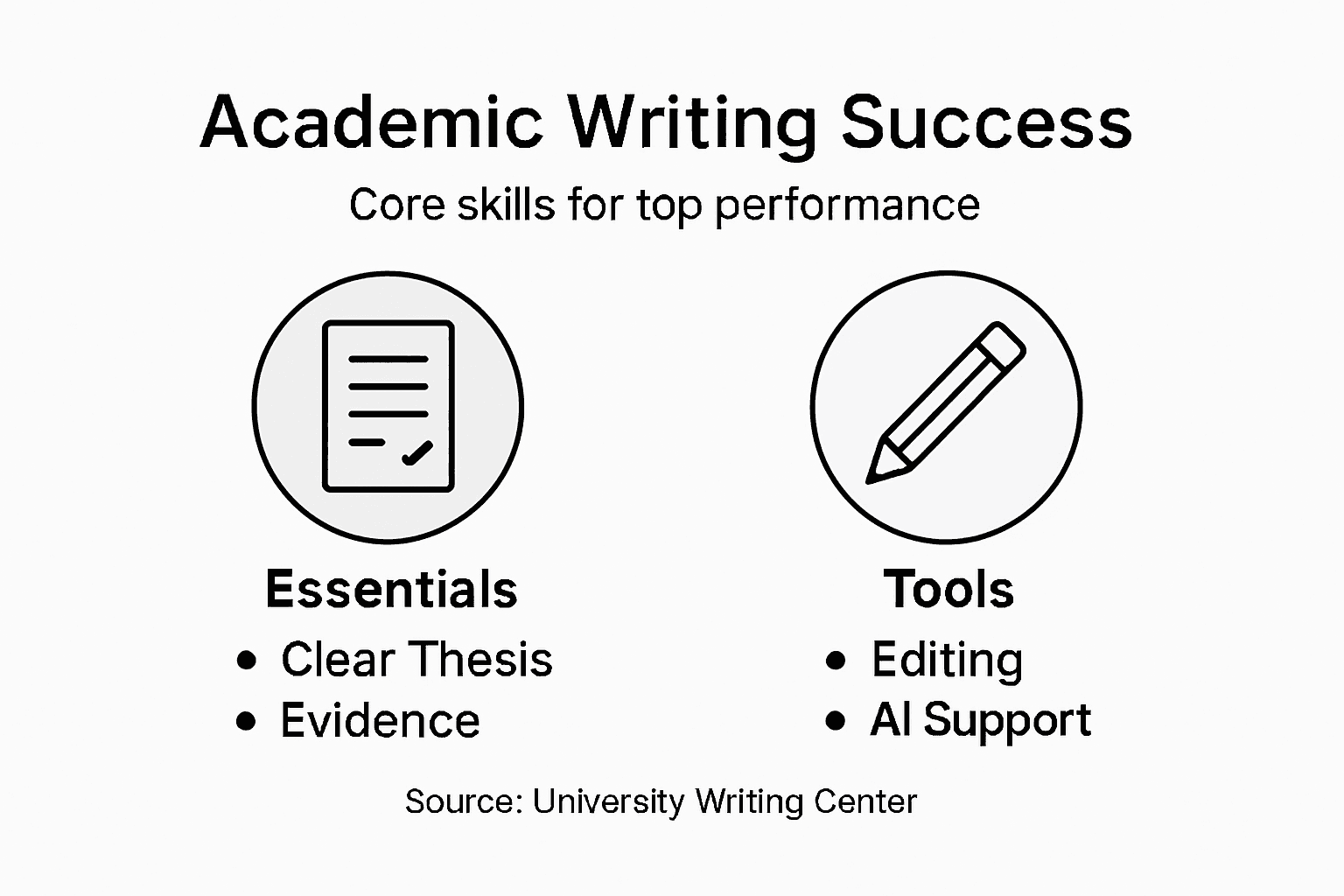
Why Improve Writing Efficiency: Real Academic Impact

Rushing to complete assignments, many students still believe the myth that good writing comes naturally, without effort or revision. In reality, writing efficiency grows from practice, strategy, and the ability to blend ideas from multiple sources into clear academic texts. Modern tools, including AI, offer new ways to manage academic workload and reduce stress, helping students sharpen critical skills while meeting tight deadlines and standards.

Table of Contents

Key Takeaways

Point Details
Writing Efficiency is Multifaceted It’s not just about speed; it involves knowledge integration and critical thinking.
Myths Undermine Understanding Common myths about writing processes can hinder students’ perceptions and strategies for academic success.
AI Tools Enhance Workflows Integrating AI can support various writing stages, making the process more efficient.
Anticipate Challenges Developing strategies to address common writing pitfalls fosters better academic performance.

Defining Writing Efficiency and Overcoming Myths

Writing efficiency represents more than just typing speed or rapid text generation. At its core, it involves strategically integrating knowledge, managing cognitive resources, and producing high-quality academic content with precision and purpose. Academic writing requires sophisticated skills that go beyond simple word production.

Research reveals that writing efficiency is deeply connected to multiple-source integration and academic writing self-efficacy. Multiple-source writing capabilities demonstrate a student’s ability to synthesize information from diverse sources into cohesive, rigorous academic texts. This process demands significant motivation, critical thinking, and technical writing skills.

Several persistent myths undermine students’ understanding of writing efficiency:

Here’s a comparison of common writing myths and the reality behind writing efficiency:

Writing Myth Reality Check Practical Implication
Writing is always easy Writing requires strategic effort Plan and divide tasks strategically
Good writers never struggle All writers revise and face challenges Value drafting and revision stages
Talent alone determines quality Skills can be learned and refined Invest in practice and feedback
First drafts should be flawless Drafts are for development and ideas Focus on progress, not perfection
  • Myth 1: Writing is an effortless, spontaneous process
  • Myth 2: Good writers never struggle with drafting
  • Myth 3: Writing quality depends solely on natural talent
  • Myth 4: First drafts should be perfect

Modern approaches challenge these misconceptions by emphasizing systematic writing strategies. AI-supported collaborative writing frameworks demonstrate how technology can enhance writing workflows without compromising scholarly standards. These methods transform writing from a solitary, challenging task into a structured, supportive process.

Successful academic writers understand that efficiency emerges from deliberate practice, strategic tool usage, and continuous skill development. They recognize writing as a complex cognitive activity requiring sustained effort, iterative refinement, and intelligent resource management.

Pro tip: Develop a personalized writing workflow that breaks complex writing tasks into manageable stages, using AI tools strategically to support—not replace—your critical thinking process.

Key Benefits for Academic Success

Academic success is not merely about grades, but about developing comprehensive skills that transform students into effective communicators and critical thinkers. Writing efficiency plays a pivotal role in this transformation, offering multifaceted advantages that extend far beyond traditional classroom performance.

AI-assisted writing tools provide significant benefits that directly contribute to academic achievement. These innovative technologies help students navigate complex writing challenges by reducing cognitive load and providing personalized feedback mechanisms.

Key benefits of improved writing efficiency include:

  • Enhanced Critical Thinking: Systematically organizing thoughts and arguments
  • Reduced Academic Stress: Breaking complex tasks into manageable components
  • Improved Time Management: Streamlining research and writing processes
  • Better Communication Skills: Developing clear, concise academic communication
  • Increased Research Proficiency: Learning to synthesize information effectively

Academic writing practices support iterative learning experiences that encourage students to view writing as a dynamic, evolving process. This approach transforms writing from a potentially intimidating task into an opportunity for intellectual growth and self-expression.

Modern academic environments recognize that writing efficiency is not about producing perfect text instantly, but about developing sustainable strategies for continuous improvement. Students who embrace these strategies position themselves for long-term academic and professional success.

Pro tip: Create a personalized writing workflow that integrates periodic self-review, leverages technological tools, and prioritizes incremental skill development.

How Efficient Writing Supports Research and Deadlines

Research productivity hinges on more than just intellectual capacity—it demands strategic writing approaches that transform complex academic projects into manageable, structured endeavors. Efficient writing acts as a critical bridge between innovative ideas and their successful academic execution, enabling researchers to navigate challenging project timelines with precision and confidence.

Academic researcher tired facing deadlines

AI-powered research writing dramatically transforms academic productivity by accelerating content generation and refining scholarly communication. These advanced tools help researchers reduce writing time while maintaining rigorous academic standards, creating a more streamlined research workflow.

Key strategies for supporting research through efficient writing include:

  • Structured Time Allocation: Breaking complex projects into manageable daily tasks
  • Systematic Research Tracking: Maintaining organized notes and source documentation
  • Progress Monitoring: Setting incremental milestones and accountability checkpoints
  • Strategic Editing: Implementing iterative review and refinement processes
  • Technology Integration: Leveraging AI tools for research assistance and writing optimization

Effective deadline management requires disciplined approaches that minimize last-minute pressures. Successful researchers develop proactive writing schedules that account for research complexity, personal productivity rhythms, and potential unexpected challenges.

Modern academic environments recognize that writing efficiency is not about working harder, but working smarter. By implementing strategic writing practices, researchers can transform potentially overwhelming projects into structured, achievable goals that consistently meet institutional standards.

Pro tip: Create a personalized research writing dashboard that tracks project stages, sets realistic deadlines, and integrates AI-assisted writing tools for continuous progress monitoring.

AI Tools and Strategies for Streamlined Workflow

The modern academic landscape demands innovative approaches to research and writing, with artificial intelligence emerging as a powerful ally in creating more efficient, sophisticated workflows. Understanding how to strategically integrate AI tools can transform the traditional writing process, enabling researchers to work smarter and more effectively.

AI-assisted academic writing requires a nuanced approach that balances technological capability with scholarly integrity. Researchers must develop critical reflexivity in their AI tool usage, ensuring that technological assistance enhances rather than replaces intellectual rigor.

Key strategies for implementing AI in academic workflows include:

  • Prompt Engineering: Crafting precise, context-specific AI instructions
  • Output Verification: Critically evaluating and refining AI-generated content
  • Ethical Integration: Maintaining academic integrity and original thought
  • Adaptive Learning: Continuously improving AI interaction techniques
  • Tool Diversification: Exploring multiple AI resources for comprehensive support

Academic AI tools offer sophisticated support across multiple research stages, from initial concept development to final manuscript refinement. These technologies provide capabilities such as citation management, language enhancement, and complex data analysis that can dramatically improve research productivity.
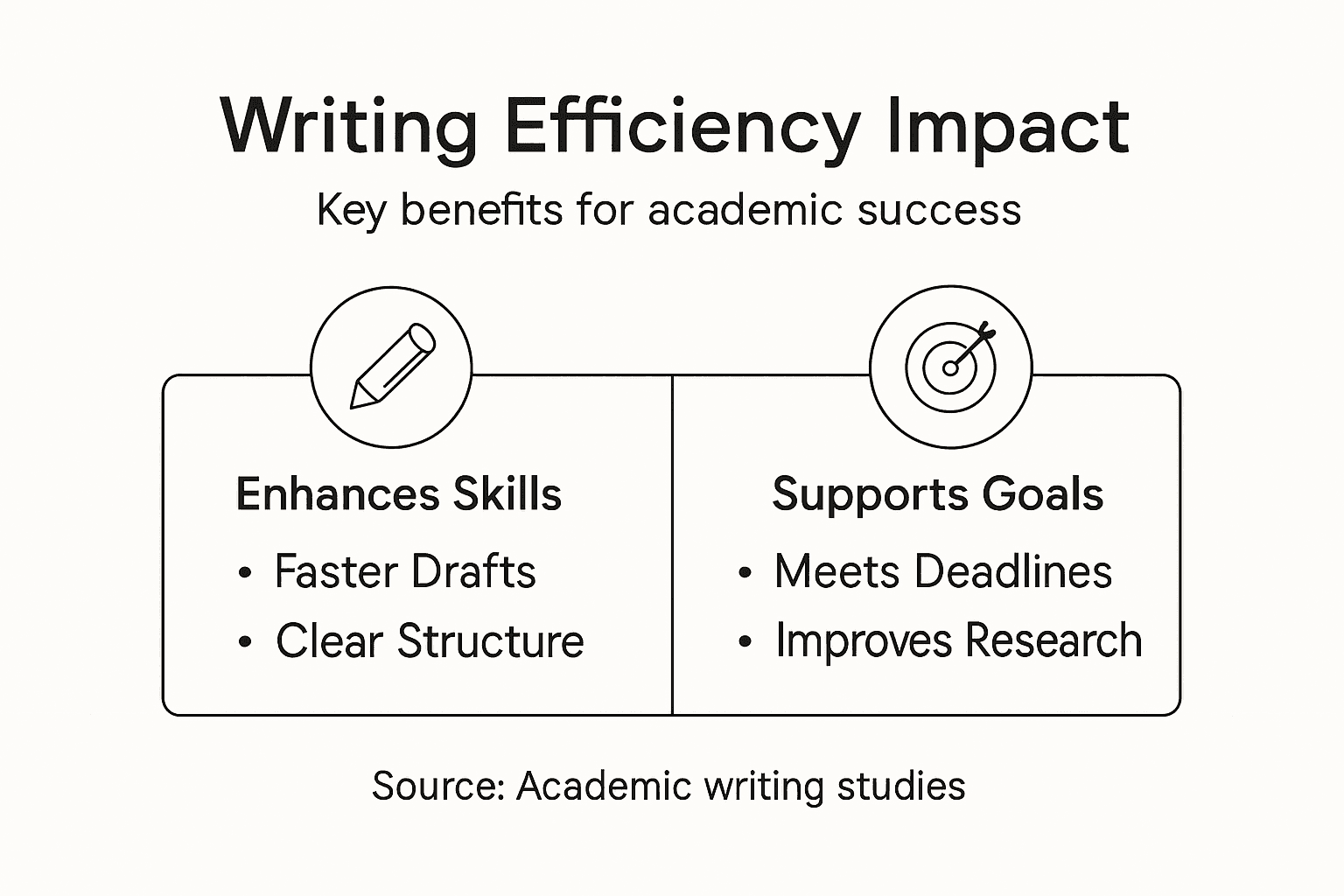
Infographic on writing efficiency academic benefits

Successful researchers view AI as a collaborative partner, not a replacement for human creativity and critical thinking. The most effective workflows integrate technological efficiency with deep intellectual engagement, allowing scholars to push the boundaries of academic exploration.

The table below summarizes how AI tools can support each stage of academic writing:

Writing Stage Potential AI Support User Role
Idea Generation Suggest topics and research questions Select and refine suggestions
Drafting Accelerate initial text production Guide structure and main points
Editing Spot grammar and style issues Review and accept changes
Citation Management Organize and format references Verify accuracy and sources
Plagiarism Checking Scan for unoriginal content Address flagged sections thoughtfully

Pro tip: Develop a systematic approach to AI tool evaluation, creating a personal rubric that assesses each tool’s reliability, relevance, and potential to enhance your specific research objectives.

Common Pitfalls and How to Avoid Them

Academic writing presents numerous challenges that can derail even the most well-intentioned research efforts. Understanding and anticipating potential obstacles is crucial for maintaining high-quality scholarly work and achieving academic success.

Research paper mistakes can significantly undermine academic credibility and performance. Students often struggle with fundamental aspects of scholarly communication that extend beyond simple content creation.

Common academic writing pitfalls include:

  • Insufficient Research: Failing to conduct comprehensive background investigation
  • Plagiarism Risks: Inadequate citation and attribution practices
  • Unclear Thesis Statements: Weak or unfocused central arguments
  • Poor Paper Organization: Disjointed and illogical document structure
  • Neglecting Proofreading: Submitting drafts with grammatical and formatting errors

Writing clarity challenges often emerge from complex linguistic constructions that obscure rather than illuminate academic ideas. Overcoming these requires a deliberate focus on concise, active language that communicates ideas directly and powerfully.

Successful academic writers develop meta-cognitive strategies that anticipate and mitigate potential writing challenges. This involves creating robust research frameworks, implementing systematic review processes, and maintaining a critical perspective on one’s own work.

Pro tip: Develop a personalized academic writing checklist that systematically addresses research, writing, and editing challenges before submitting any scholarly document.

Boost Your Academic Writing Efficiency with AI Support

The article highlights challenges like overcoming writing myths, managing research deadlines, and integrating AI tools effectively to enhance academic writing. It emphasizes pain points such as struggling with drafting, inefficient time management, and balancing quality with productivity. By focusing on terms like multiple-source integration, strategic writing workflows, and AI-assisted writing, the content clearly shows the need for smart, affordable, and user-friendly solutions.

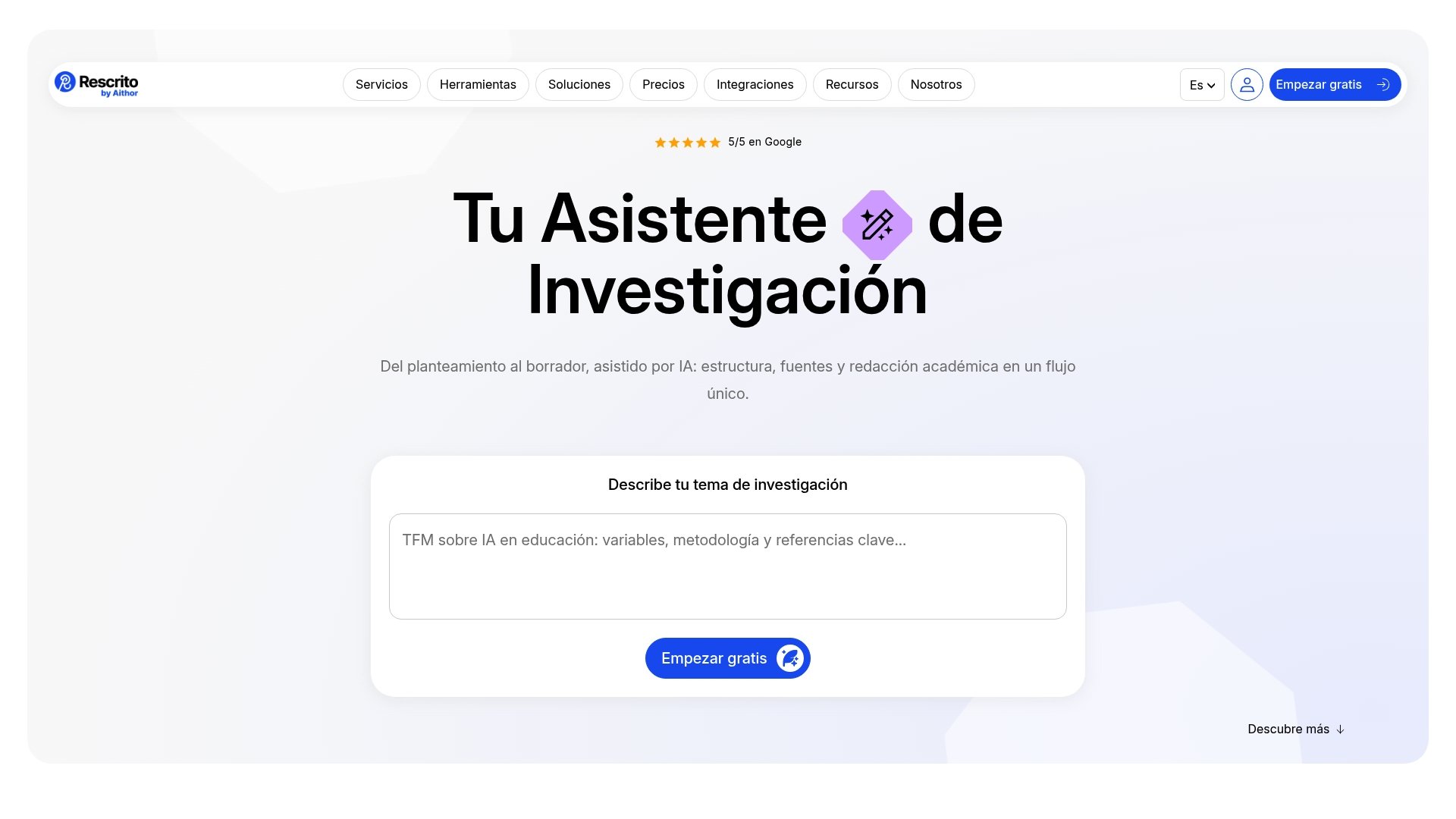
Rescrito.com answers this call by offering a comprehensive AI platform designed to improve your writing quality while saving valuable time. Whether you want to streamline drafting, organize complex research, or receive intelligent feedback, Rescrito’s advanced tools help you develop a personalized workflow that aligns with the article’s recommended strategies. Enjoy features like text refinement, project organization, and voice-enabled interactions that bring clarity and critical thinking to your academic work.
https://rescrito.com/en/home/

Ready to transform your academic writing process? Visit Rescrito.com today, explore how AI can bolster your multiple-source writing skills, and start managing your research deadlines with confidence. Take advantage of the platform’s affordability and premium options to unlock features like GPT-5 access and unlimited prompts. Don’t wait to work smarter and write better—your next breakthrough is just a click away at Rescrito’s homepage. For deeper insights into AI-powered writing workflows, explore AI-assisted academic writing and begin your journey toward efficient, impactful writing.

Frequently Asked Questions

What is writing efficiency in academic writing?

Writing efficiency refers to the ability to strategically integrate knowledge and manage cognitive resources while producing high-quality academic content with precision and purpose. It emphasizes the importance of structured writing practices over mere speed.

How can overcoming writing myths improve academic performance?

Overcoming myths such as the belief that writing is always easy or that good writers never struggle fosters a more realistic approach. It encourages students to value the drafting and revision processes, which ultimately leads to improved writing skills and academic success.

What role do AI tools play in enhancing writing efficiency?

AI tools significantly streamline the writing process by providing personalized feedback, helping to manage complex information, and improving overall productivity. They empower researchers to focus on critical thinking while reducing the cognitive load associated with writing tasks.

What are common pitfalls in academic writing and how can they be avoided?

Common pitfalls include insufficient research, plagiarism risks, unclear thesis statements, poor organization, and neglecting proofreading. These can be avoided by creating a structured writing framework, implementing systematic review processes, and developing a checklist for research and editing challenges.


Role of AI in Publishing: Transforming Content Creation

Keeping readers engaged while managing a constant writing workload has never felt more complex for North American content creators and digital marketers. As artificial intelligence transforms publishing, affordable AI tools now promise faster content creation, smarter editing, and improved research support. The challenge lies not just in picking the right tool but in understanding how AI-powered workflow enhancements are reshaping every stage of the publishing process, balancing efficiency, quality, and ethical responsibility.

Table of Contents

Key Takeaways

Point Details
AI Reshapes Publishing Artificial Intelligence is transforming content creation, editing, and distribution, offering enhanced manuscript quality and faster processes.
Collaboration is Key Publishers, researchers, and technology developers are working together to integrate AI responsibly, focusing on scholarly integrity.
Workflow Efficiency AI tools streamline workflows, allowing researchers to concentrate on high-value tasks and enhance productivity.
Ethical Considerations The integration of AI raises significant ethical concerns, necessitating transparent governance and careful monitoring of its applications in publishing.

Defining AI’s Impact on Publishing Today

Artificial Intelligence (AI) is fundamentally reshaping the publishing landscape, introducing unprecedented transformations in content creation, editing, and distribution. Academic publishing technologies have experienced significant disruption, with generative AI platforms demonstrating capabilities that challenge traditional content production methods.

The technological revolution encompasses multiple dimensions of publishing, presenting both extraordinary opportunities and complex ethical considerations. Key impacts include:

  • Accelerated content generation speeds
  • Enhanced manuscript quality through intelligent editing
  • Automated research synthesis
  • Improved peer review processes
  • More sophisticated content recommendation systems

Collaborative Transformation is emerging as a critical strategy. Publishers, researchers, and technology developers are increasingly working together to integrate AI responsibly, ensuring technological advancements align with scholarly integrity.

Research publication pipelines are being comprehensively reimagined, with AI technologies automating complex workflows and reducing manual intervention. This shift allows human experts to focus on higher-value creative and analytical tasks, rather than repetitive administrative processes.

The most profound changes are occurring in manuscript development, where AI can now draft initial research outlines, suggest structural improvements, and even help identify potential research gaps. These capabilities are not about replacing human creativity but augmenting and accelerating intellectual work.

Pro-tip: Embrace AI as a collaborative tool, not a replacement for human expertise, by continuously updating your skills and understanding of emerging technologies.

Key Types of AI Tools for Publishers

Publishers are increasingly leveraging sophisticated AI technologies to streamline complex workflows and enhance content production. Academic publishing platforms now incorporate advanced tools that transform traditional editorial processes across multiple dimensions.

The most prominent AI tools for publishers can be categorized into several key functional areas:

  • Manuscript Screening: Automated systems for initial submission evaluation
  • Plagiarism Detection: Advanced algorithmic content comparison
  • Peer Review Assistance: AI-powered recommendation and quality assessment
  • Content Discovery: Intelligent recommendation engines
  • Metadata Tagging: Semantic analysis and intelligent categorization
  • Language Enhancement: Grammar, style, and clarity improvement tools

Natural Language Processing (NLP) stands at the core of these technological innovations, enabling more nuanced and intelligent interactions between human experts and machine-driven insights. Semantic search capabilities are particularly transformative, allowing publishers to create more sophisticated content recommendation systems and improve research discoverability.

These AI tools are not designed to replace human expertise but to augment and accelerate scholarly work. By automating repetitive tasks, they free researchers and editors to focus on high-value creative and analytical activities that require human judgment and critical thinking.

Moreover, the integration of AI tools helps publishers reduce operational costs, minimize human error, and create more efficient editorial workflows. The technology enables faster manuscript processing, more accurate peer reviews, and enhanced quality control mechanisms that maintain academic integrity.

Here’s a summary of how AI transforms key stages in the publishing workflow:

Workflow Stage Traditional Process AI-Enhanced Process
Manuscript Screening Manual review by editors Automated initial evaluation
Peer Review Management Manual reviewer selection AI-powered recommendations
Editing and Proofreading Human editing for style/quality Intelligent language enhancement
Content Distribution Human-driven recommendations Data-driven suggestion engines

Pro tip: Implement AI tools incrementally, starting with low-risk processes like metadata tagging and gradually expanding to more complex workflows to ensure smooth technological integration.

How AI Enhances Workflow and Productivity

Research productivity tools are revolutionizing how academic professionals approach complex work processes. By leveraging artificial intelligence, researchers can now streamline time-consuming tasks and focus more intensively on creative and critical thinking endeavors.

The primary workflow enhancements delivered by AI technologies include:

  • Automatic Literature Review: Rapid synthesis of research materials
  • Manuscript Editing: Intelligent language and style refinement
  • Data Analysis: Quick statistical processing and insight generation
  • Writing Assistance: Idea generation and structural recommendations
  • Language Translation: Breaking international communication barriers

Cognitive Support Systems represent a significant breakthrough in professional productivity. These advanced tools provide real-time feedback, suggesting improvements and highlighting potential areas of enhancement across various scholarly activities.

Scholarly publishing workflows are being transformed by AI’s ability to automate repetitive tasks, allowing researchers to redirect their energy towards more substantive intellectual contributions. The technology particularly supports non-native English speakers by providing sophisticated language editing and communication assistance.

Publishing assistant automating tasks with AI

Moreover, AI tools are democratizing academic research by reducing traditional barriers to publication. They offer intelligent support that helps researchers overcome linguistic challenges, improve manuscript quality, and increase the likelihood of successful publication across global platforms.

Pro tip: Integrate AI tools gradually into your workflow, starting with low-stakes tasks like grammar checking and progressively expanding to more complex research support functions.

Risks, Costs, and Ethical Concerns in Publishing AI

Scientific publishing ethics are being fundamentally challenged by the rapid integration of artificial intelligence technologies. The emergence of AI tools introduces complex ethical dilemmas that require careful navigation by researchers, publishers, and academic institutions.

The primary ethical concerns in AI-driven publishing can be categorized into several critical areas:

  • Originality Risks: Potential diminishment of independent scholarly thinking
  • Plagiarism Concerns: Increased likelihood of unintentional content reproduction
  • Critical Thinking Challenges: Over-reliance on automated content generation
  • Data Privacy Issues: Potential misuse of research and personal information
  • Algorithmic Bias: Systematic discrimination in content selection and evaluation

Transparency and Accountability represent fundamental principles in managing AI integration. Scholarly publishing governance demands comprehensive policies that ensure human oversight and maintain rigorous academic standards.

Cost considerations extend beyond financial investments. Organizations must allocate significant resources to develop robust monitoring systems, train personnel in ethical AI usage, and continuously update governance frameworks. These expenses include technological infrastructure, ongoing training, and potential legal compliance mechanisms.

Moreover, the human element remains irreplaceable. While AI can streamline processes, it cannot replicate the nuanced judgment, creative insight, and ethical reasoning that human researchers bring to academic discourse. Balancing technological efficiency with intellectual integrity becomes paramount.

Pro tip: Develop a clear institutional policy for AI tool usage, including transparent disclosure requirements and guidelines for appropriate AI-assisted research practices.

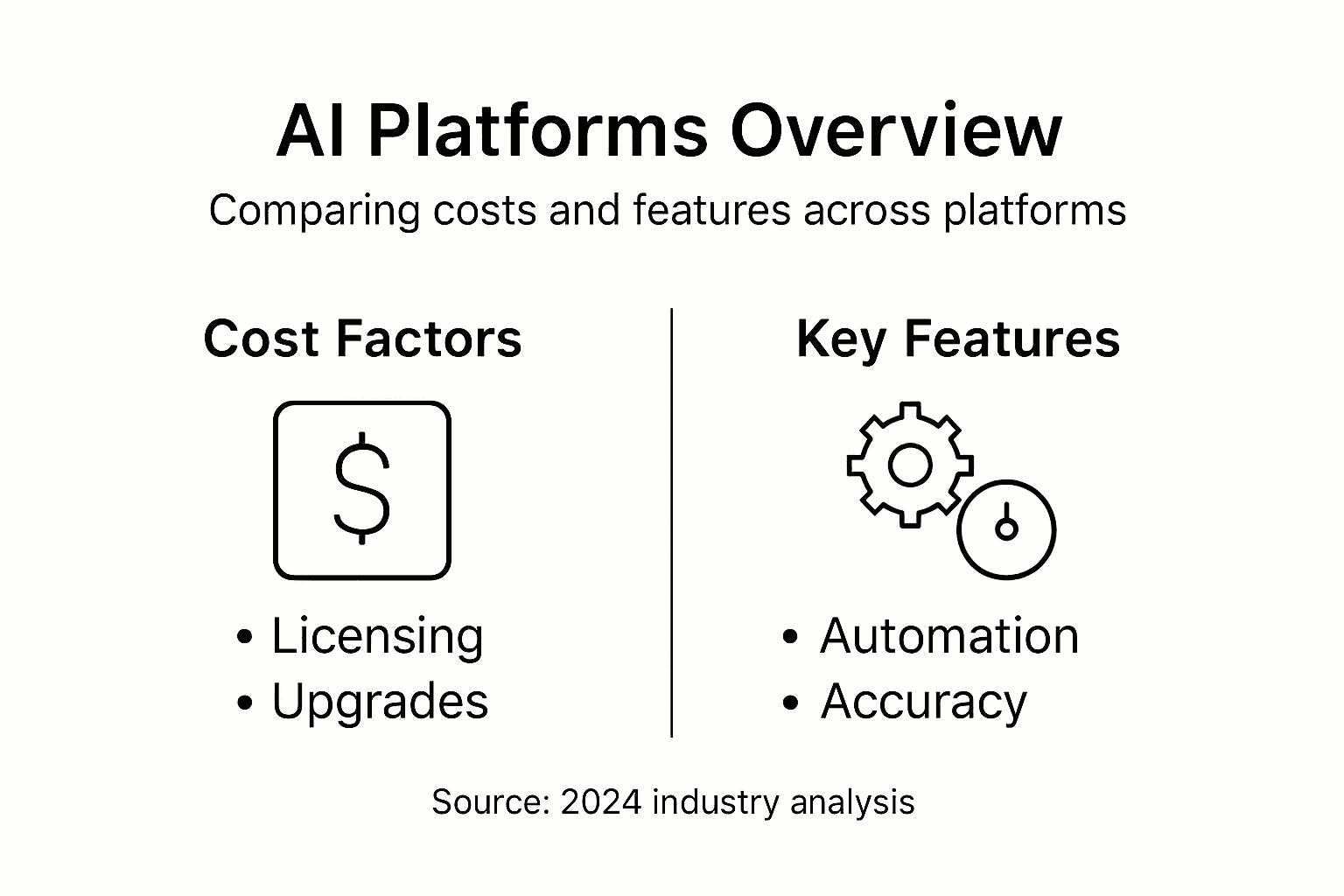
Comparing AI Platforms and Affordability

Generative AI platform accessibility varies significantly across different research environments, creating complex challenges for publishers and academic institutions seeking technological integration. Understanding these variations is crucial for making informed technological investments.

Key comparative factors for AI platforms include:

  • Pricing Structures: Subscription vs. usage-based models
  • Functionality Range: Basic editing to advanced research assistance
  • Scalability Options: Individual vs. institutional licensing
  • Performance Metrics: Speed, accuracy, and language support
  • Integration Capabilities: Compatibility with existing research systems

Cost Considerations extend beyond initial financial investments. Publisher AI technology selection involves evaluating long-term operational expenses, including training, maintenance, and potential customization requirements.

Infographic comparing AI publishing platforms

Smaller research organizations often face significant barriers to entry, with many advanced AI platforms demanding substantial financial commitments. This economic disparity can create technological inequities, potentially limiting access for less-funded institutions and researchers in developing regions.

Moreover, affordability should not compromise ethical standards or technological quality. Publishers must balance cost-effectiveness with robust performance, ensuring that chosen AI platforms maintain high standards of accuracy, transparency, and academic integrity.

This table compares the major costs and challenges of adopting AI platforms in publishing:

Challenge Area Small Organizations Large Institutions
Financial Investment High initial cost burden Easier budget allocation
Training Resources Limited staff capacity Dedicated training teams
Technology Upgrades Infrastructure constraints Scalable IT resources
Ethical Compliance Difficulty maintaining standards Formal governance policies

Pro tip: Conduct a comprehensive cost-benefit analysis that considers not just pricing, but also potential productivity gains and long-term research efficiency when selecting AI platforms.

Harness AI to Revolutionize Your Publishing Workflow Today

The article reveals how AI is reshaping content creation and scholarly publishing by accelerating manuscript development, enhancing editing accuracy, and streamlining research workflows. If you struggle with managing complex writing projects, ensuring language clarity, or generating fresh ideas, these challenges can slow down your productivity and reduce your impact. Key issues like intelligent language enhancement, idea generation, and workflow organization directly affect your success in academic and professional publishing.

At Rescrito.com, we understand these hurdles and offer a comprehensive AI-powered platform designed to boost your writing quality and efficiency. Our tools support text refinement, project organization, and idea generation, all tailored to improve your content creation process while respecting the ethical standards essential in scholarly publishing. Whether you need advanced editing assistance or seamless integration with chat tools like WhatsApp and Telegram, Rescrito makes it easier and more affordable to embrace AI responsibly.

https://rescrito.com/en/home/

Discover how you can transform your publishing experience with AI solutions that prioritize clarity, productivity, and ethical integrity. Start today by visiting Rescrito.com. Explore our features to unlock unlimited prompts, GPT-5 access, and robust text processing capabilities that empower your research and creative writing journey. Don’t wait—enhance your academic and professional content creation now with AI designed for your success.

Frequently Asked Questions

How is AI transforming content creation in publishing?

AI is reshaping content creation by enhancing manuscript development, enabling faster content generation, improving editing processes, and automating research synthesis. It allows publishers to maintain higher quality standards while accelerating productivity.

What are the key AI tools available for publishers?

Key AI tools include manuscript screening, plagiarism detection, peer review assistance, content discovery engines, metadata tagging, and language enhancement tools, all designed to streamline editorial processes and improve content quality.

What are the ethical concerns associated with AI in publishing?

Ethical concerns include originality risks, potential plagiarism, over-reliance on automated processes, data privacy issues, and algorithmic bias. It’s crucial for organizations to develop transparent policies for AI usage in academic publishing.

How can publishers integrate AI tools into their workflows?

Publishers can integrate AI tools incrementally, starting with low-risk tasks such as metadata tagging and gradually incorporating more complex functions like automated literature reviews and editing, ensuring a smooth transition into AI-enhanced processes.

Role of AI in Editing: Transforming Text Quality

Finding the right balance between quality and speed is a daily challenge for content creators. The demand for precise, polished text never slows, and traditional editing often eats up valuable hours. AI editing is redefining how writers boost productivity, offering intelligent tools for grammar checking and style refinement that rival human-written text quality. This article breaks down what sets AI editing apart, empowering you to choose solutions that fit your workflow and preserve your creative edge.

Table of Contents

Key Takeaways

Point Details
AI Editing Enhances Workflows AI editing tools streamline content creation, enabling faster editing cycles and improved writing quality.
Collaboration is Key Writers should use AI as a supportive tool rather than a replacement for human creativity and voice.
Ethical Considerations are Crucial Clear guidelines regarding authorship and AI usage are necessary to maintain research integrity and academic standards.
Continuous Learning is Essential Ongoing evaluation of AI suggestions and updates in AI literacy will help mitigate risks and enhance writing outcomes.

Defining AI Editing in Content Creation

Artificial intelligence is dramatically reshaping content creation workflows, introducing powerful editing capabilities that transform how writers refine and enhance their work. AI editing represents a sophisticated technological approach to improving text quality, leveraging advanced machine learning algorithms to analyze, suggest improvements, and optimize written communication.

At its core, AI editing involves intelligent content transformation strategies that go beyond traditional spell-checking and grammar correction. These sophisticated tools can now:

  • Analyze overall writing clarity and coherence
  • Suggest structural improvements in document organization
  • Detect nuanced language and tone inconsistencies
  • Provide context-aware recommendations for more effective communication
  • Generate alternative phrasing options

The technological landscape of AI editing is fundamentally driven by generative artificial intelligence models trained on massive datasets of high-quality writing. These models understand linguistic patterns, grammatical structures, and contextual nuances far more comprehensively than previous editing technologies.

AI editing tools are not replacements for human creativity, but powerful collaborators that amplify writers’ existing skills and potential.

Professional content creators are increasingly adopting these technologies to streamline their workflows and enhance text quality. Generative AI technologies can generate content matching human-written text quality, providing writers with intelligent assistance throughout the editing process.

Key Benefits of AI Editing:

  1. Faster editing cycles
  2. Improved writing consistency
  3. Enhanced language precision
  4. Objective writing analysis
  5. Reduced manual editing time

Pro tip: Always review AI-generated suggestions critically and maintain your unique writing voice, using AI as a collaborative tool rather than an absolute authority.

Here’s a comparison of traditional editing and AI editing in content creation:

Aspect Traditional Editing AI Editing
Speed Manual, time-intensive Automated, rapid suggestions
Consistency Varies by editor Uniform across documents
Scalability Limited by human resources Can handle large volumes easily
Insight Depth Dependent on editor skill Data-driven, context-aware
Adaptability Requires retraining staff Continuous improvement via updates

Types of AI Editing Tools and Technologies

AI editing technologies have evolved into sophisticated systems with diverse capabilities designed to enhance writing quality across multiple domains. Advanced natural language processing applications now offer comprehensive editing solutions that transform traditional writing and editing workflows.

Key Categories of AI Editing Tools:

  • Grammar and Syntax Checkers: Advanced tools analyzing sentence structure
  • Style Enhancement Engines: Algorithms improving writing clarity and tone
  • Contextual Language Optimization: Systems detecting nuanced communication issues
  • Plagiarism Detection Platforms: AI-powered originality verification tools
  • Translation and Multilingual Editing: Cross-language editing capabilities

These technologies leverage complex machine learning models trained on extensive linguistic datasets. Modern AI editing technologies employ sophisticated natural language processing to compare texts against massive language databases, detecting intricate grammatical and stylistic inconsistencies.

AI editing tools represent a paradigm shift in content refinement, offering unprecedented precision and analytical depth.

Professional content creators can now access specialized AI editing tools tailored to specific writing domains:

  1. Academic Research Editing
  2. Technical Documentation Enhancement
  3. Creative Writing Optimization
  4. Business Communication Refinement
  5. Journalistic Content Polishing

AI Editing Technology Capabilities:

  • Real-time error detection
  • Contextual suggestion generation
  • Writing style consistency maintenance
  • Advanced language complexity management
  • Multilingual text optimization

Pro tip: Select AI editing tools that complement your specific writing needs and always maintain human oversight during the editing process.

Writer using AI editing software on laptop

How AI Editing Tools Improve Workflow

AI editing tools have fundamentally transformed professional writing workflows, offering unprecedented efficiency and precision in content creation. Scholarly workflows now leverage AI to automate repetitive tasks, enabling writers to concentrate on more strategic and creative aspects of their work.

Key Workflow Enhancement Strategies:

  • Automated initial draft generation
  • Real-time grammatical and stylistic suggestions
  • Instant plagiarism and originality checks
  • Comprehensive language optimization
  • Seamless collaboration and version tracking

These advanced technologies dramatically reduce manual editing time by rapidly synthesizing research information and providing intelligent content recommendations. Machine learning algorithms analyze writing patterns, suggesting improvements that maintain the author’s unique voice while enhancing overall communication effectiveness.

AI editing tools are not replacements for human creativity, but powerful amplifiers of professional writing potential.

Professional content creators benefit from AI editing tools across multiple domains:

  1. Academic Research Documentation
  2. Technical Writing Projects
  3. Creative Content Development
  4. Marketing Communication Strategies
  5. Journalistic Content Production

Workflow Optimization Capabilities:

  • Accelerated content creation
  • Enhanced writing consistency
  • Reduced manual editing time
  • Improved language precision
  • Cross-platform compatibility

Pro tip: Integrate AI editing tools progressively, maintaining human oversight and using them as collaborative assistants rather than absolute authorities.

Automation, Consistency, and Creative Impact

The intersection of artificial intelligence and content creation represents a transformative landscape where automation reshapes editorial processes with unprecedented precision and efficiency. AI technologies are not simply tools, but sophisticated collaborators that enhance human creativity while streamlining complex writing workflows.

Core Dimensions of AI-Driven Content Enhancement:

  • Intelligent error detection and correction
  • Contextual language optimization
  • Rapid content generation
  • Consistent stylistic adaptation
  • Advanced linguistic pattern recognition

Automation in editing goes far beyond simple grammatical checks. Machine learning algorithms now analyze entire documents, understanding nuanced communication contexts and providing suggestions that preserve the writer’s unique voice while improving overall text quality.

AI editing represents a symbiotic relationship between technological precision and human creativity.

The creative impact of AI editing tools manifests through multiple strategic approaches:

  1. Suggesting alternative phrasing
  2. Identifying potential structural improvements
  3. Offering genre-specific writing recommendations
  4. Detecting subtle tone inconsistencies
  5. Generating innovative content variations

Transformative Creative Capabilities:

  • Inspiration generation
  • Writing complexity management
  • Linguistic diversity exploration
  • Intellectual cross-pollination
  • Creative boundary expansion

Pro tip: Approach AI editing as a collaborative partner, using its suggestions as creative springboards while maintaining your unique authorial perspective.

Risks, Limitations, and Common Pitfalls

Artificial intelligence editing technologies, while powerful, introduce significant challenges that demand critical understanding and proactive management. Academic writing faces substantial risks from unchecked AI adoption, requiring careful navigation of emerging technological complexities.

Primary Risks in AI Editing:

  • Potential for unintentional plagiarism
  • Reduction of critical thinking skills
  • Generation of fabricated or misleading content
  • Erosion of original writing capabilities
  • Embedded algorithmic biases

The most profound limitation of AI editing tools lies in their inability to fully comprehend nuanced human communication. Machine learning algorithms, despite their sophistication, struggle to capture the intricate contextual subtleties that human writers naturally understand.

AI technologies are powerful assistants, not infallible replacement for human intellectual engagement.

Regulatory challenges in academic AI use represent another critical concern for content creators:

  1. Unclear authorship attribution
  2. Ethical transparency issues
  3. Potential information fabrication
  4. Diminished research originality
  5. Institutional policy gaps

Key Mitigation Strategies:

  • Implement rigorous human oversight
  • Develop institutional AI usage guidelines
  • Maintain critical evaluation of AI suggestions
  • Preserve individual writing voice
  • Continuously update AI literacy skills

Pro tip: Always approach AI editing tools as collaborative assistants, never as autonomous decision-makers, and maintain a skeptical yet open mindset towards their recommendations.

The following table summarizes the main risks and best mitigation strategies for AI editing adoption:

Risk Area Possible Impact Key Mitigation Strategy
Plagiarism Inappropriate content use Use reputable AI tools, verify
Bias in Output Unintended discrimination Review, diversify training data
Loss of Originality Generic or formulaic writing Preserve unique writing style
Ethical Uncertainty Questionable authorship/credit Disclose AI usage, set policies

Artificial intelligence technologies are dramatically transforming academic writing, introducing complex ethical and legal challenges that demand nuanced understanding. Academic writing integration raises critical transparency questions, requiring comprehensive frameworks to maintain research integrity and intellectual accountability.

Key Ethical Considerations:

  • Authorship attribution
  • Intellectual property rights
  • Transparency of AI assistance
  • Academic integrity maintenance
  • Research originality preservation

The emerging landscape of AI-assisted writing challenges traditional legal frameworks, particularly in determining genuine human intellectual contribution. Machine learning algorithms can generate sophisticated content, blurring the lines between human and artificial creativity.

Ethical AI use demands clear disclosure, substantial human oversight, and commitment to academic standards.

Regulatory policies must adapt to AI’s academic impact, addressing several critical domains:

  1. Copyright protection mechanisms
  2. Plagiarism detection standards
  3. Data security protocols
  4. Institutional accountability frameworks
  5. International collaborative guidelines

Fundamental Legal Principles:

  • Mandatory AI usage disclosure
  • Clear attribution requirements
  • Institutional review processes
  • Ongoing ethical training
  • Adaptive regulatory mechanisms

Pro tip: Develop a transparent workflow documenting AI tool usage, ensuring each AI-assisted document includes clear acknowledgment of technological assistance.

Elevate Your Writing Quality with AI Editing Tools at Rescrito

The article highlights the challenges of maintaining consistency, clarity, and originality in writing while managing the risks and limitations of AI editing technologies. If you are struggling to streamline your content creation workflow or want to enhance your writing precision without losing your unique voice, Rescrito.com offers a comprehensive solution. Our advanced AI-powered platform not only assists you in refining and organizing your text but also supports idea generation, language optimization, and project management. These features directly address the need for faster editing cycles, improved coherence, and critical human oversight emphasized in the article.

https://rescrito.com/en/home/

Discover how you can harness the transformative power of AI editing with tools designed to keep you in control while amplifying your creativity. Visit Rescrito Main Page to explore all features and take advantage of premium offerings like unlimited prompts and GPT-5 access. Start improving your text quality today and experience a smarter, more affordable way to write efficiently with Rescrito.

Frequently Asked Questions

What is AI editing in content creation?

AI editing refers to the use of artificial intelligence technologies to enhance and refine written text. It employs machine learning algorithms to analyze writing clarity, consistency, and tone, providing suggestions for improvements beyond traditional editing methods.

How can AI editing tools improve writing quality?

AI editing tools improve writing quality by offering real-time suggestions for grammar, style, and structure, optimizing language and tone, and identifying potential issues like plagiarism—all while allowing writers to maintain their unique voice.

What are the benefits of using AI editing tools?

Benefits of AI editing tools include faster editing cycles, improved writing consistency, enhanced language precision, objective writing analysis, and reduced manual editing time, enabling writers to focus on more creative aspects of their work.

Are there risks associated with using AI editing technologies?

Yes, risks include potential unintentional plagiarism, the erosion of original writing skills, and biases embedded in the AI algorithms. It’s essential to maintain human oversight and a critical approach to AI-generated suggestions.

Chat-Based AI: Transforming Writing for Creators

Every writer knows the struggle of facing a blank page or juggling countless scattered notes. For American students and North American content creators, finding smart ways to organize ideas and spark inspiration is more crucial than ever. With the rise of chat-based AI, powered by advanced large language models and natural language processing, you now have access to affordable tools that act as collaborative partners in the writing process. Discover how these intelligent systems transform content creation and simplify your workflow.

Table of Contents

Key Takeaways

Point Details
Chat-Based AI Overview Chat-based AI utilizes advanced natural language processing to simulate human-like conversations through large language models and machine learning algorithms.
Technological Evolution Modern chatbots, like ChatGPT and Bard, leverage deep learning and neural network architectures to deliver dynamic and context-aware interactions.
Streamlined Content Creation These technologies enhance productivity by facilitating rapid draft generation, language enhancement, and efficient research assistance.
Consideration of Limitations Users must be aware of biases, misinformation risks, and the need for human oversight to validate AI-generated content.

Defining Chat-Based AI and Core Concepts

Chat-based AI represents a revolutionary technological advancement in artificial intelligence, enabling machines to engage in human-like conversations through sophisticated language processing techniques. These generative AI systems are powered by complex large language models that can understand, interpret, and generate contextually appropriate responses across diverse domains.

At its core, chat-based AI leverages advanced natural language processing techniques to simulate intelligent conversation. The fundamental components include:

  • Machine Learning Algorithms: Enable systems to learn and improve from interactions
  • Natural Language Processing (NLP): Helps AI understand human language nuances
  • Large Language Models: Provide extensive knowledge base for generating responses
  • Neural Network Architectures: Support complex pattern recognition and generation

The technological foundation of these AI systems relies on training models with massive datasets, allowing them to develop sophisticated understanding and generation capabilities. Student-driven technologies have demonstrated remarkable potential in educational and professional contexts, offering personalized assistance and stimulating critical thinking.

Modern chat-based AI goes beyond simple text generation, functioning as an interactive tool that can adapt to user needs, provide contextual information, and even assist in complex problem-solving tasks. These systems represent a significant leap from traditional computational approaches, introducing more dynamic and responsive technological interactions.

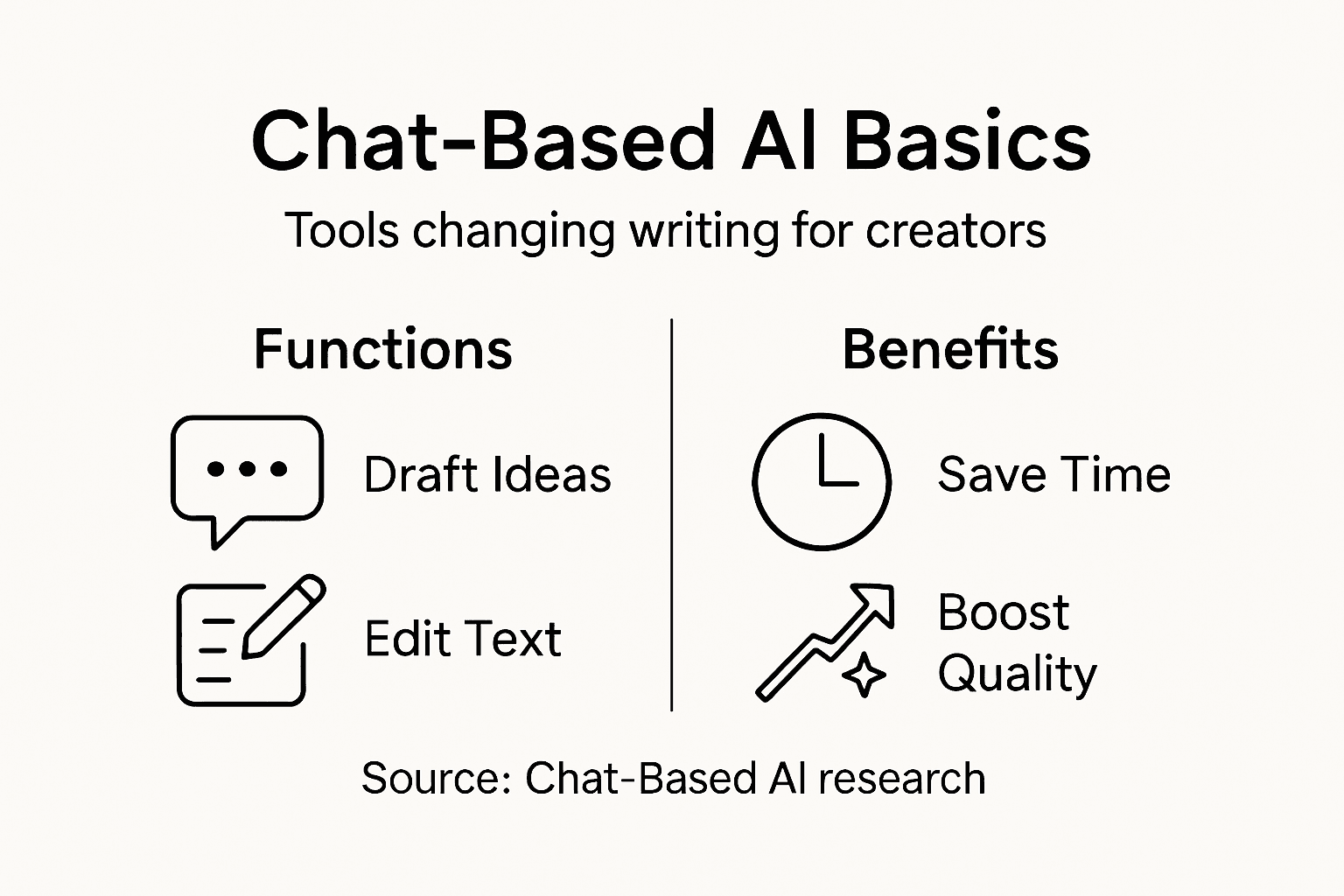
Infographic shows key functions and benefits of chat-based AI

Pro tip: Always verify AI-generated content and use these tools as collaborative assistants rather than complete replacements for human creativity and critical thinking.

Types and Technologies Powering Chat-Based AI

Chat-based AI technologies have rapidly evolved, transforming from simple rule-based systems to sophisticated conversational agents powered by advanced computational frameworks. Modern chatbot architectures now leverage complex machine learning techniques that enable dynamic, context-aware interactions across multiple domains.

The landscape of chat-based AI is diverse, with multiple prominent technologies representing different capabilities:

  • Large Language Models (LLMs): Provide extensive knowledge base and generative capabilities
  • Neural Network Architectures: Enable sophisticated pattern recognition
  • Natural Language Processing (NLP): Supports nuanced language understanding
  • Deep Learning Algorithms: Power adaptive and intelligent response generation

Specific AI chatbot variants demonstrate the technological breadth in this field. Varied AI chatbot technologies like ChatGPT, Bard, Llama, Ernie, and Grok showcase unique strengths:

  • ChatGPT: Exceptional in educational and humanities tasks
  • Bard: Integrates real-time internet information
  • Llama: Open-source with strong personalization features
  • Ernie: Specialized in Chinese language applications

These technologies represent more than simple text generation tools. They are sophisticated systems capable of understanding context, generating human-like responses, and adapting to complex communication scenarios. The underlying technologies combine machine learning, natural language processing, and advanced neural networks to create increasingly intelligent conversational experiences.

The chart below compares popular chat-based AI technologies and highlights their unique features and ideal use cases:

AI Technology Key Feature Ideal Use Case
ChatGPT Strong humanities focus Academic research, essays
Bard Real-time web integration Up-to-date information tasks
Llama Open-source, customizable Personalization, development
Ernie Advanced Chinese language Mandarin language projects
Grok Conversational engagement Social interaction, support

Pro tip: Experiment with multiple AI chatbots to understand their unique strengths and limitations, helping you select the most appropriate tool for your specific communication needs.

How Chat-Based AI Streamlines Content Creation

Content creation has undergone a transformative shift with the emergence of chat-based AI technologies that dramatically reduce production time and enhance creative workflows. Generative AI tools empower researchers to accelerate manuscript preparation, overcome language barriers, and generate coherent initial drafts across multiple disciplines.

The key mechanisms of content streamlining include several critical capabilities:

  • Rapid Draft Generation: Quickly produce initial content frameworks
  • Language Enhancement: Provide sophisticated grammar and style suggestions
  • Research Assistance: Help synthesize complex information efficiently
  • Editing Support: Offer targeted refinements and structural improvements

By leveraging advanced large language model capabilities, content creators can dramatically transform their productivity. The AI acts as an intelligent collaborative tool, enabling users to:

  • Generate initial content drafts
  • Refine complex writing structures
  • Provide contextual language recommendations
  • Overcome writer’s block through prompt-based ideation

These technologies represent more than simple writing assistants. They are sophisticated cognitive tools that understand context, adapt to specific writing styles, and provide nuanced support across academic, professional, and creative writing domains. The intelligent algorithms can analyze writing patterns, suggest improvements, and help creators develop more polished and compelling content with unprecedented efficiency.

Student editing essay with chat AI in kitchen

Pro tip: Develop a collaborative workflow with AI by treating it as a creative partner, using its suggestions as a starting point and always applying your unique human perspective and critical thinking.

Real-World Applications for Students and Creators

Chat-based AI has revolutionized practical learning and creative workflows, offering unprecedented support across academic and professional domains. AI chatbots transform educational experiences by providing personalized learning assistance, immediate homework support, and adaptive skill development strategies.

For students and creators, these technologies offer diverse practical applications:

  • Academic Research: Assist in literature reviews and information synthesis
  • Writing Support: Help draft, edit, and refine academic papers
  • Skill Development: Provide interactive tutoring and skill-building exercises
  • Project Management: Organize research materials and brainstorm ideas

Pedagogical uses of AI chatbots extend far beyond simple text generation. These intelligent systems function as:

  • Virtual mentors offering formative feedback
  • Personalized tutors for skill development
  • Collaborative learning facilitators
  • Administrative task automators

The transformative potential of chat-based AI lies in its ability to provide customized, immediate support across multiple domains. These technologies are not replacement tools but intelligent assistants that amplify human creativity, critical thinking, and problem-solving capabilities. By understanding individual learning styles and project requirements, AI can deliver targeted guidance that enhances overall productivity and learning outcomes.

Pro tip: Approach AI as a collaborative partner, always maintaining your critical judgment and using its suggestions as a starting point for deeper exploration and personal insight.

Costs, Limitations, and Common Pitfalls

Chat-based AI technologies, while transformative, come with significant challenges that users must carefully navigate. AI chatbots present complex ethical considerations that demand critical evaluation and responsible implementation across academic and professional contexts.

The key limitations of current chat-based AI technologies include:

  • Information Reliability: Potential for generating misleading or incorrect information
  • Bias Amplification: Inherited biases from training data sets
  • Lack of Contextual Understanding: Struggles with nuanced or complex scenarios
  • Attribution Challenges: Unclear boundaries of content ownership

Ethical concerns surrounding AI development highlight several critical pitfalls:

  • Potential privacy violations
  • Risk of misinformation generation
  • Unintended plagiarism
  • Inability to take responsibility for generated content

These technologies are not infallible tools but sophisticated assistants requiring human oversight. Creators and students must approach AI as a collaborative partner, maintaining critical thinking and understanding that AI-generated content needs thorough verification and careful interpretation. The most effective use involves treating these tools as advanced suggestion engines rather than absolute sources of truth.

Here’s a summary of common challenges with chat-based AI and why human oversight remains important:

Limitation Why Human Oversight Is Needed
Misinformation risk To verify facts and ensure accuracy
Bias amplification To spot and correct unintended preconceptions
Misinterpretation of context To clarify nuanced or ambiguous requests
Attribution issues To maintain ethical content ownership

Pro tip: Always cross-reference AI-generated content with authoritative sources and maintain a skeptical, analytical approach to ensure accuracy and integrity.

Unlock Your Writing Potential with Advanced AI Assistance

The article highlights the challenges of managing complex writing tasks and the critical need for reliable, context-aware support to enhance productivity—as well as the importance of overcoming issues like misinformation risk and writer’s block. If you want to elevate your content creation workflow while ensuring clarity and accuracy, Rescrito.com offers a powerful solution tailored for students, professionals, and creators alike. With features such as intelligent text refinement, idea generation, and project organization, it helps you streamline your work without sacrificing creativity or critical judgment.

https://rescrito.com/en/home/

Experience the future of AI writing assistance by visiting Rescrito.com. Start transforming your drafts into polished final pieces with our affordable, multilingual platform that integrates seamlessly with tools like WhatsApp and Telegram for voice-enabled interactions. Don’t let common AI pitfalls hold you back—empower your writing process today with Rescrito.com’s intelligent content solutions and boost your productivity by accessing features designed to overcome those very limitations discussed in the article. Take the first step now to unlock premium capabilities including GPT-5 access and unlimited prompts at a fraction of typical costs.

Frequently Asked Questions

How does chat-based AI enhance content creation?

Chat-based AI enhances content creation by rapidly generating draft ideas, providing language enhancement suggestions, and assisting with research and editing, significantly speeding up the writing process.

What are the main limitations of chat-based AI tools?

The main limitations include the risk of generating misleading information, potential bias from training data, difficulty in understanding complex contexts, and challenges related to content attribution.

How can I effectively collaborate with chat-based AI when writing?

To effectively collaborate with chat-based AI, treat it as a creative partner by using its suggestions as starting points, refining them with your personal insights, and maintaining critical thinking throughout the process.

In what ways are chat-based AI technologies applied in educational contexts?

Chat-based AI technologies are applied in educational contexts by providing personalized learning assistance, aiding in academic research, offering writing support, and helping with project management tasks.

AI Writing Assistant Explained: Smarter Content Creation

Struggling to keep up with complex writing assignments or tight deadlines is a familiar challenge for many university students and early-career professionals. The rise of AI writing assistants is changing this reality, offering practical tools that support everything from initial draft creation to final edits. These intelligent applications use advanced natural language processing to generate, edit, and improve written content, making academic tasks faster and more manageable. Discover how the latest AI solutions can simplify your writing process while supporting your academic and professional goals.

Table of Contents

Key Takeaways

Point Details
Advanced Capabilities AI writing assistants offer diverse functionalities beyond grammar checking, including content generation and real-time suggestions.
Types of Assistants Various AI writing tools cater to different needs, such as academic, creative, and professional writing.
Critical Evaluation Required Users must review AI-generated content for accuracy and originality to maintain scholarly integrity.
Cost versus Value While many AI writing assistants provide free versions, advanced features often require subscriptions, making cost analysis essential.

Defining AI Writing Assistants Today

Artificial Intelligence (AI) writing assistants represent a transformative technological advancement in content creation, offering unprecedented capabilities for students, researchers, and professionals. These sophisticated digital tools leverage advanced natural language processing algorithms to generate, edit, and enhance written content with remarkable precision and efficiency.

At their core, AI writing assistants are intelligent software platforms that use machine learning models to support various writing tasks. Their capabilities extend far beyond simple grammar checking, encompassing a range of sophisticated functions:

  • Generating original draft content
  • Providing real-time writing suggestions
  • Improving sentence structure and coherence
  • Analyzing text complexity and readability
  • Offering contextual vocabulary recommendations
  • Detecting potential plagiarism risks

The technological foundation of these tools relies on complex language models trained on massive datasets. Extensive language processing techniques enable these systems to understand context, generate human-like text, and provide nuanced writing recommendations.

Developer working on language model code

Modern AI writing assistants are particularly valuable in academic and professional contexts, where precision and clarity are paramount. Generative AI tools have rapidly transformed writing workflows, offering researchers and students powerful assistance in manuscript preparation, content generation, and editorial refinement.

Pro tip: Always review and critically evaluate AI-generated content to ensure accuracy and maintain your unique writing voice.

Types and Core Capabilities Compared

AI writing assistants come in diverse forms, each designed to address specific writing challenges and support different user needs. Understanding their unique capabilities helps researchers and students select the most appropriate tool for their specific requirements.

The primary categories of AI writing assistants can be broadly classified into several specialized types:

  • Academic Writing Assistants: Focused on research papers, thesis development, and scholarly content
  • Creative Writing Tools: Designed for fiction, storytelling, and creative content generation
  • Professional Writing Platforms: Tailored for business communications, reports, and technical documentation
  • Language Learning Assistants: Supporting grammar, style, and language skill improvement
  • Multilingual Writing Tools: Offering translation and cross-language writing support

Advanced research writing tools demonstrate remarkable versatility in scientific writing contexts, providing capabilities that extend beyond traditional writing support. These sophisticated platforms can assist researchers in complex tasks such as document creation, literature exploration, and academic manuscript preparation.

Each AI writing assistant type offers unique strengths. Academic tools prioritize citation management and scholarly language, while creative platforms emphasize narrative flow and imaginative expression. Professional writing assistants focus on clarity, concision, and industry-specific communication standards.

Performance metrics vary significantly across different AI writing assistant categories. Factors like accuracy, contextual understanding, and domain-specific knowledge play crucial roles in determining their effectiveness. Researchers and professionals must carefully evaluate these tools based on their specific workflow requirements and writing objectives.

Here’s how the main types of AI writing assistants differ in their primary focus and user benefits:

Assistant Type Primary Focus Ideal Users Key Benefit
Academic Writing Research manuscripts Students, scholars Precision in scholarly tone
Creative Writing Fiction, storytelling Authors, creators Enhanced imaginative output
Professional Platforms Business documentation Professionals Clarity in workplace writing
Language Learning Grammar and style support Language learners Personalized skill feedback
Multilingual Tools Translation assistance Global writers Effective cross-language use

Pro tip: Experiment with multiple AI writing assistants to understand their individual strengths and find the tool that best complements your unique writing style.

Advanced Features Transforming Workflows

AI writing assistants have evolved beyond basic editing tools, introducing transformative features that fundamentally reshape academic and professional writing processes. These advanced capabilities go far beyond traditional grammar and spell-checking, offering sophisticated support across multiple stages of content creation.

Advanced academic writing workflows now encompass six critical domains where AI provides substantial assistance:

  • Idea generation and research design
  • Content structuring and organization
  • Literature review and synthesis
  • Data management and analysis
  • Editing and publication preparation
  • Multi-language communication support

The most groundbreaking features of modern AI writing assistants include real-time intelligent suggestions that adapt to individual writing styles. These systems can now provide context-aware recommendations, helping users improve sentence structure, clarity, and overall document coherence.

Generative AI tools have introduced unprecedented automation capabilities, handling complex tasks such as:

  • Automated citation management
  • Formatting assistance
  • Drafting initial document structures
  • Argument development support
  • Comprehensive language polishing

While these advanced features offer remarkable potential, users must remain critically engaged. AI recommendations should be carefully evaluated to maintain academic integrity and ensure the authenticity of scholarly work.

Pro tip: Customize your AI writing assistant’s settings to align with your specific writing style and disciplinary requirements.

Real-World Uses for Students and Creators

AI writing assistants have rapidly transformed how students and creators approach content development, offering unprecedented support across diverse academic and creative domains. These powerful tools extend far beyond simple editing, becoming collaborative partners in the writing process.

Higher education writing support demonstrates significant benefits for students, particularly in developing critical writing skills:

  • Improving linguistic precision
  • Enhancing logical reasoning
  • Supporting structural organization
  • Facilitating idea generation
  • Maintaining academic writing standards
  • Providing personalized feedback

For academic writers, AI assistants serve multiple critical functions. They help non-native English speakers navigate complex language nuances, provide instant grammatical corrections, and offer suggestions for improving overall document coherence. Research papers, theses, and scholarly articles can be refined more efficiently with these intelligent tools.

AI-powered writing tools offer remarkable advantages for creators across different domains. Content creators, journalists, and independent writers can leverage these technologies to:

  • Overcome writer’s block
  • Streamline editing processes
  • Receive real-time writing suggestions
  • Improve overall writing clarity
  • Experiment with different writing styles
  • Generate initial draft content

Creative professionals particularly benefit from AI writing assistants’ ability to provide objective feedback and alternative phrasing suggestions. These tools help break through creative barriers while maintaining the writer’s unique voice and artistic integrity.

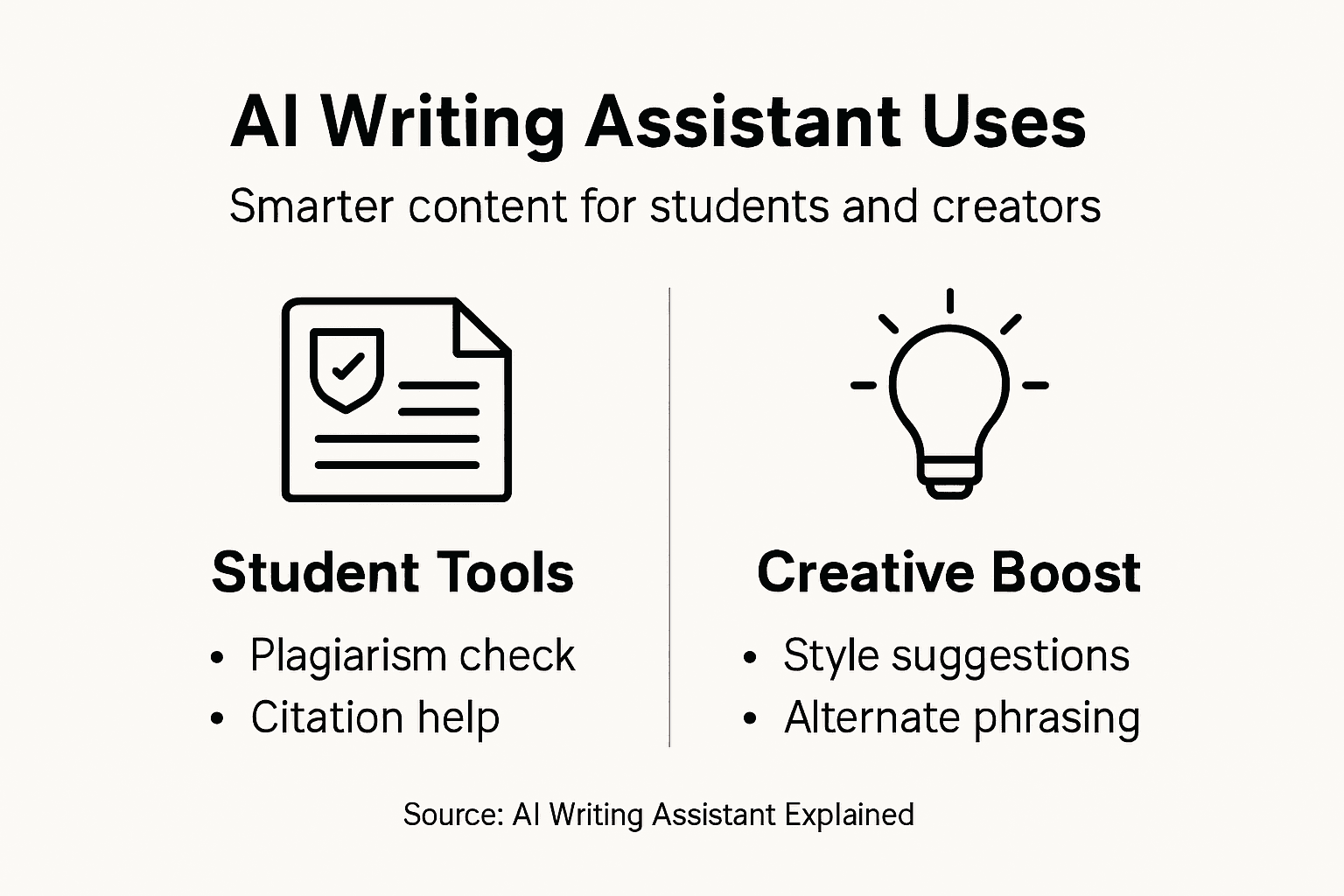
Infographic showing AI assistant benefits

Pro tip: Treat AI writing assistants as collaborative tools, not replacements for your creativity and critical thinking.

Costs, Limitations, and Common Pitfalls

AI writing assistants, while powerful and transformative, are not infallible tools. Understanding their inherent limitations is crucial for responsible and effective utilization across academic and professional contexts.

Generative AI writing challenges present several significant concerns that users must carefully navigate:

  • Potential for content plagiarism
  • Risk of generating fabricated information
  • Inconsistent citation accuracy
  • Variable output quality
  • Lack of genuine critical thinking
  • Potential algorithmic biases

The most critical limitation involves AI hallucinations, where writing tools generate seemingly plausible but entirely fictional content. These fabricated passages can appear convincing, making manual verification absolutely essential. Researchers and writers must approach AI-generated text with rigorous scrutiny, treating these tools as assistants rather than authoritative sources.

Academic research integrity demands transparent and ethical AI tool usage. Users should understand that while AI can streamline writing processes, it cannot replace human judgment, originality, and scholarly rigor. The technology should augment, not substitute, critical human intellectual engagement.

Cost considerations also play a significant role in AI writing assistant adoption. While many tools offer free tiers, advanced features typically require paid subscriptions. Users must evaluate the return on investment, balancing potential productivity gains against financial expenditures.

The following table summarizes common limitations of AI writing assistants and recommended solutions for effective use:

Limitation Description Recommended Strategy
Content hallucination Generates plausible false text Manual fact-checking
Citation inaccuracy Errors in citation formatting Verify sources independently
Algorithmic bias Output reflects training data bias Use diverse, ethical sources
Variable output quality Inconsistent content quality Test outputs before publishing
Lack of critical thinking No true analytical skills Add your own analysis

Pro tip: Always cross-reference and independently verify any AI-generated content before incorporating it into your final document.

Unlock Smarter Writing with Rescrito Today

Struggling with AI hallucinations or the challenge of maintaining your unique voice when using AI writing assistants The article highlighted the need for careful evaluation and personalized styling in AI-generated content. Rescrito.com offers a comprehensive solution designed to enhance your writing clarity while preserving your authenticity. Whether you are a student, researcher, or creator you can benefit from advanced features like real-time text refinement, idea generation, and even voice-enabled interactions that align perfectly with the critical recommendations found in the article.

https://rescrito.com/en/home/

Experience AI writing assistance that understands your specific academic or creative goals and empowers you to work smarter not harder Explore the full range of affordable premium tools including GPT-5 access and unlimited prompts on Rescrito.com Stay ahead in your writing tasks by visiting Rescrito home and take control of your content development with tools that address the very challenges this article discusses. Start transforming your writing workflow now.

Frequently Asked Questions

What is an AI writing assistant?

AI writing assistants are intelligent software platforms that use advanced natural language processing algorithms to generate, edit, and enhance written content efficiently. They can assist with various writing tasks, including grammar checking, content generation, and editing.

How can AI writing assistants benefit academic writers?

AI writing assistants can help academic writers by improving linguistic precision, enhancing logical reasoning, supporting structural organization, and providing personalized feedback on their writing. They are particularly valuable for refining research papers and scholarly articles.

What are the main types of AI writing assistants?

The main types of AI writing assistants include academic writing assistants, creative writing tools, professional writing platforms, language learning assistants, and multilingual writing tools. Each type is designed to address specific writing challenges and user needs.

What should I keep in mind when using AI writing assistants?

When using AI writing assistants, it’s important to critically evaluate the generated content for accuracy and originality. Users should also consider the limitations of these tools, such as the potential for content hallucinations and citation inaccuracies, and always perform manual verification of the information provided.

7 Essential Scholarly Writing Tips for Graduate Humanities

Starting a humanities thesis often feels overwhelming. You have to find a unique topic, refine your research question, master academic writing styles, and keep your work organized from idea to final draft. Without clear strategies, it is easy to lose focus and get stuck along the way.

This guide gives you practical steps that turn thesis writing challenges into manageable tasks. You will discover proven methods for developing your research question, organizing your chapters, citing sources, and editing your work for clarity and flow.

Each actionable tip will help you approach your thesis with confidence and keep your writing on track. Get ready for insights that make every stage of the process easier and more effective.

Table of Contents

Quick Summary

Takeaway Explanation
1. Craft a Sharp Research Question Develop an original and specific research question to guide your thesis effectively. It should invite critical analysis and be researchable.
2. Create a Detailed Outline A strong outline acts as a roadmap for your thesis, ensuring logical progression of ideas and structured presentation of arguments.
3. Select and Analyze Evidence Choose compelling evidence to support your arguments while ensuring each piece connects deeply to your thesis and is critically integrated.
4. Adhere to Accurate Citation Mastering citation style in your discipline maintains academic integrity. Ensure all sources are accurately referenced and relevant to your work.
5. Revise for Coherence and Clarity Systematic revision enhances argument clarity and flow. Read your work from a critical perspective and seek feedback from peers.

1. Understand Your Thesis and Research Question

Crafting a compelling humanities thesis begins with developing a razor-sharp research question that serves as the intellectual compass for your entire project. Your research question is not just a starting point it is the fundamental framework that will guide your entire scholarly investigation.

In humanities research a robust research question must possess several critical characteristics:

  • Originality: Must present a unique perspective or unexplored angle
  • Specificity: Narrow enough to be thoroughly investigated
  • Complexity: Should invite critical analysis and scholarly debate
  • Researchability: Requires sufficient available academic resources

The research process is inherently iterative. Doctoral training emphasizes structured research question development through ongoing dialogue with peers and supervisors. This collaborative approach helps refine your initial question into a sophisticated scholarly inquiry.

A well-crafted research question transforms your thesis from a mere academic exercise into a meaningful intellectual contribution.

To develop your research question, start by conducting an extensive literature review. Identify gaps in existing scholarship and determine where your unique perspective can make a meaningful intervention. Read widely across your field read critically and take detailed notes on potential research angles.

Your thesis statement will emerge from this research question a concise articulation of your central argument. It should be debatable clear and specific enough to guide your entire research process.

Pro tip: Schedule monthly meetings with your academic advisor to review and refine your research question throughout your thesis development process.

2. Organize Ideas with Clear Structure and Outlines

Successful scholarly writing hinges on meticulous organizational strategies that transform scattered thoughts into a coherent academic narrative. Creating a robust outline is like building an intellectual roadmap that guides your entire research journey.

Humanities thesis writing demands a structured format that ensures logical progression and academic rigor. Your outline serves as the critical blueprint for presenting complex ideas systematically.

Key elements of an effective thesis outline include:

  • Introduction: Framing your research question and thesis statement
  • Literature Review: Contextualizing existing scholarship
  • Methodology: Explaining research approach and theoretical framework
  • Analytical Chapters: Presenting evidence and arguments
  • Conclusion: Synthesizing findings and implications

A well-structured outline transforms intellectual chaos into scholarly clarity.

To develop a powerful outline start by identifying your core arguments. Map out how each section will contribute to your overarching scholarly narrative. Think of your outline as a conversation you are having with academic peers where each section builds logically upon the previous one.

Consider creating a detailed chapter breakdown that includes potential subsections subtopics and key evidence you plan to explore. This granular approach helps prevent writer’s block and provides a clear roadmap for your research.

Digital tools like mind mapping software or academic writing platforms can help visualize and refine your outline. Experiment with different organizational approaches until you find a structure that feels natural and compelling.

Pro tip: Revisit and revise your outline every month to ensure it remains aligned with your evolving research insights and scholarly discoveries.

3. Use Evidence Effectively to Support Arguments

In scholarly writing evidence is the backbone of intellectual credibility. Your ability to select analyze and integrate compelling evidence determines the strength and persuasiveness of your academic argument.

Effective evidence deployment requires strategic thinking and nuanced research skills. Think of evidence as the building blocks that transform your theoretical claims from speculation into substantive scholarly discourse.

Key strategies for using evidence powerfully include:

  • Critical Selection: Choose sources that directly support your argument
  • Contextual Integration: Explain how each piece of evidence connects to your thesis
  • Analytical Depth: Go beyond mere description to offer sophisticated interpretation
  • Diverse Source Types: Incorporate primary texts secondary scholarship and interdisciplinary perspectives
  • Transparent Attribution: Always correctly cite your sources

Academic arguments are built not just on what evidence you choose but how thoughtfully you analyze it.

When incorporating evidence follow a clear analytical pattern. First introduce the source then quote or paraphrase directly explain its significance and demonstrate how it supports your specific argument. This quote sandwich technique ensures your voice remains central while leveraging scholarly sources.

Avoid two common pitfalls: over-quoting and under-analyzing. Each piece of evidence should do meaningful work in your argument. Ask yourself: Does this specific quote or source advance my intellectual contribution?

Develop a systematic approach to evidence gathering. Create research databases spreadsheets or digital note-taking systems that allow you to track sources annotate insights and quickly retrieve relevant materials.

Pro tip: Dedicate one hour each week to critically reviewing and reorganizing your evidence collection to maintain research momentum and analytical clarity.

4. Incorporate and Cite Sources Accurately

Mastering source citation is the cornerstone of academic integrity in humanities research. Your ability to accurately reference and integrate scholarly sources demonstrates intellectual rigor and respect for academic discourse.

Academic writing demands precision in source documentation to maintain scholarly credibility and transparency. Citations are more than just technical requirements they are a dialogue with existing scholarship.

Key principles of effective source incorporation include:

  • Consistent Style: Adhere to your discipline’s preferred citation format
  • Contextual Attribution: Explain the significance of each source
  • Precise Quoting: Use direct and indirect quotes strategically
  • Full Reference Details: Include complete bibliographic information
  • Avoid Plagiarism: Always distinguish between your ideas and others’

Citations are the intellectual breadcrumbs that guide readers through your scholarly argument.

Different humanities disciplines prefer specific citation styles:

  1. Modern Language Association (MLA) for literature and arts
  2. Chicago Manual of Style for history and social sciences
  3. American Psychological Association (APA) for interdisciplinary research

Create a systematic approach to tracking sources. Digital reference management tools like Zotero or EndNote can help you organize citations efficiently and generate bibliographies automatically.

When incorporating sources critically analyze their relevance. Do not simply include quotes to fill space. Each citation should advance your argument provide evidence or offer a counterpoint to your thesis.

Pro tip: Develop a color-coded system in your research notes to distinguish between direct quotes paraphrased content and your original analysis.

5. Write Clearly with Precise Academic Language

Mastering academic language requires intentional communication skills that transform complex ideas into clear intellectual discourse. Your writing should illuminate ideas not obscure them.

Effective scholarly communication demands precision in academic writing that balances complexity with clarity. Academic language is a sophisticated tool for intellectual exploration.

Key strategies for developing precise academic language include:

  • Active Voice: Prioritize direct sentence structures
  • Precise Vocabulary: Choose words with exact meaning
  • Avoid Redundancy: Eliminate unnecessary words
  • Maintain Objectivity: Use neutral academic tone
  • Complex but Clear: Build sophisticated arguments accessibly

Academic writing communicates complex ideas through disciplined linguistic choices.

Transform your writing by developing a systematic approach to language refinement. Read your work aloud to identify awkward phrasings. Create a personal editing checklist that targets common academic writing pitfalls like passive voice overuse and unnecessary jargon.

Professional academic writing requires consistent grammatical discipline. Learn your discipline’s specific stylistic conventions. Different humanities fields like literature history and philosophy have nuanced language expectations.

Develop a practice of critical self-editing. After completing a draft set the text aside for 24 hours then return with fresh eyes. Look for opportunities to make your language more precise economical and impactful.

Pro tip: Maintain a personal academic vocabulary journal where you collect precise discipline-specific terms and analyze their most effective uses.

6. Revise and Edit for Coherence and Flow

Transforming a rough draft into a polished scholarly manuscript requires systematic revision and strategic editing. Your first draft captures ideas your revision process refines them into intellectual excellence.

Effective thesis writing demands multiple comprehensive revisions that enhance argument development and scholarly communication. Editing is not just correction it is intellectual refinement.

Key revision strategies include:

  • Structural Analysis: Evaluate overall argument progression
  • Paragraph Transitions: Ensure smooth logical connections
  • Argumentative Clarity: Sharpen thesis statements
  • Language Precision: Eliminate redundant or unclear phrasing
  • Critical Distance: Read work from a detached perspective

Masterful academic writing emerges through thoughtful iterative refinement.

Develop a systematic revision approach that breaks the process into distinct stages:

  1. Structural review of overall argument
  2. Paragraph level coherence check
  3. Sentence level clarity assessment
  4. Technical grammar and style refinement
  5. Final proofread for technical errors

Seek feedback from multiple sources. Academic supervisors peer reviewers and colleagues can offer perspectives that illuminate blind spots in your writing. Each external perspective provides an opportunity to strengthen your scholarly narrative.

Consider reading your draft aloud. Auditory review reveals awkward phrasings and structural inconsistencies that silent reading might miss. This technique helps identify areas needing smoother transitions or more precise language.

Pro tip: Schedule at least three distinct revision sessions with minimum 24-hour breaks between each to maintain fresh critical perspective.

7. Employ AI Tools for Efficient Writing Assistance

Artificial intelligence has transformed academic writing providing powerful technological support for scholarly research. Strategic AI integration can dramatically enhance your writing efficiency and scholarly precision.

Graduate writing benefits from intelligent technological assistance while maintaining academic integrity and intellectual originality.

Beneficial AI writing tools can support humanities scholars through:

  • Language Enhancement: Improve grammatical structure and clarity
  • Citation Management: Track and format references automatically
  • Plagiarism Detection: Ensure original scholarly contributions
  • Research Organization: Categorize and synthesize research materials
  • Draft Refinement: Suggest structural and stylistic improvements

AI tools are intellectual companions not replacements for scholarly thought.

When employing AI writing assistance maintain a critical perspective. Use these tools as supportive technological resources not as primary content generators. The intellectual rigor remains your responsibility.

Develop a systematic approach to AI tool integration. Learn the specific capabilities of different platforms. Understand their strengths and limitations. Some tools excel at grammar checking while others provide more comprehensive research support.

Evaluate AI suggestions critically. Not every recommendation will align with your scholarly voice or disciplinary conventions. Treat AI suggestions as helpful suggestions not absolute directives.

Pro tip: Create a personal workflow that integrates AI tools strategically allowing technological assistance while preserving your unique scholarly perspective.

Below is a comprehensive table summarizing key strategies and steps for crafting a humanities thesis, as presented in the article.

Aspect Recommendations Benefits
Thesis Development Develop a specific, original, and researchable question through review and refinement. Provides a clear intellectual focus for the scholarly project.
Organizational Structure Design a comprehensive outline, including key sections like introduction, analysis, and conclusion. Ensures logical progression and clarity in the research narrative.
Effective Use of Evidence Select diverse sources, integrate contextually, and provide analytical evaluation of the evidence. Enhances the strength and credibility of academic arguments.
Source Citation Use consistent citation styles, ensure precise attribution, and critically incorporate references. Demonstrates academic integrity and supports the scholarly discussion.
Language Precision Employ clear, precise language, maintaining objectivity and coherence in the argumentative text. Facilitates effective communication of complex academic ideas.
Revision Process Commit to multiple structured revision sessions to refine content progressively and enhance clarity. Transforms initial drafts into polished scholarly documents.
AI Integration Use tools for grammar checks, reference management, and content refinement with critical oversight. Improves efficiency without compromising intellectual rigor.

Elevate Your Graduate Humanities Writing with Smart AI Support

Graduate humanities students face unique challenges such as crafting precise research questions, organizing complex ideas, and mastering clear academic language. This article highlights how effective evidence use and structured revision are essential yet demanding steps in scholarly writing. If you are seeking a way to streamline these tasks and maintain intellectual rigor throughout your thesis journey, consider leveraging advanced AI tools designed specifically to enhance writing quality and workflow efficiency.

https://rescrito.com/en/home/

Unlock powerful solutions at Rescrito.com where you can improve your text clarity, organize research seamlessly, and refine your drafts with intelligent assistance tailored for academic excellence. Don’t let the pressure of citation accuracy or language precision slow you down. Visit Rescrito.com now and transform your humanities thesis writing with AI that respects your unique scholarly voice. Act today to benefit from affordable premium features that help you command your research with confidence and clarity.

Frequently Asked Questions

How do I develop a strong research question for my humanities thesis?

To develop a strong research question, focus on originality, specificity, complexity, and researchability. Start by conducting a literature review to find gaps in existing scholarship and consider your unique perspective. Aim to refine your question into a clear statement that can guide your research process.

What should I include in my thesis outline?

Your thesis outline should include key sections such as the Introduction, Literature Review, Methodology, Analytical Chapters, and Conclusion. Map out your core arguments in each section to create a logical progression throughout your research journey. Regularly revisit your outline to ensure it aligns with your developing insights.

How can I effectively incorporate evidence into my arguments?

Use evidence by selecting sources that directly support your argument and explaining their significance. Structure your analysis using the “quote sandwich technique” to ensure clarity and coherence. Dedicate time weekly to review and reorganize your evidence collection for maintaining momentum in your argument development.

What is the importance of accurate citation in scholarly writing?

Accurate citation is crucial for maintaining academic integrity and demonstrating respect for existing scholarship. Consistently use the preferred citation style for your discipline and ensure you provide full reference details. Create a systematic method for tracking your sources to make this process easier and prevent plagiarism.

How can I improve the clarity of my academic writing?

To improve clarity, focus on using precise vocabulary and active voice while avoiding unnecessary redundancy. Develop a checklist for common writing pitfalls and consider reading your work aloud to identify areas that require improvement. Maintain this practice consistently to refine your academic language over time.

What are effective strategies for revising and editing my thesis?

Effective revision involves a structured approach: first review your overall argument, then check for coherence at the paragraph level, followed by sentence clarity, and finally technical grammar. Schedule at least three distinct revision sessions, allowing breaks between them to maintain a fresh perspective. Seek feedback from peers to identify areas for improvement.

Voice-Enabled Writing Assistants: Boosting Academic Success

Finding the right voice-enabled writing assistant can feel daunting, especially when academic demands and multilingual needs collide. As these AI-powered voice tools now offer real-time speech-to-text transcription and intelligent text organization, they are transforming how students and educators tackle essays and research papers. Whether you need quick idea capture or tailored support for diverse languages, the following guide will help you understand the features, benefits, and challenges of these innovative solutions.

Table of Contents

Key Takeaways

Point Details
Voice-Enabled Writing Assistants Enhance Academic Writing These tools utilize advanced speech recognition and natural language processing to convert speech into structured text, improving efficiency and accessibility.
Multilingual Capabilities Offer Global Support Voice-enabled writing assistants provide features such as automatic language detection and real-time translation, making them valuable for users from diverse linguistic backgrounds.
Collaboration Features Foster Interdisciplinary Research Tools facilitate hands-free literature searches, automatic citation management, and real-time document editing, promoting seamless academic collaboration.
Ethical Considerations Must Be Addressed Institutions should establish guidelines to avoid risks like plagiarism and maintain academic integrity while using AI-driven writing tools.

Defining Voice-Enabled Writing Assistants

Voice-enabled writing assistants represent an innovative technological solution that transforms academic writing through advanced speech recognition and natural language processing capabilities. These sophisticated digital tools leverage artificial intelligence to convert spoken language into structured, coherent written content, addressing complex writing challenges across multiple academic disciplines.

Unlike traditional writing methods, AI-powered chatbots employ advanced NLP to provide intelligent, conversational writing support. These systems have dramatically evolved from early rule-based models to complex deep learning platforms capable of understanding context, tone, and academic requirements.

Key features of voice-enabled writing assistants include:

  • Real-time speech-to-text transcription
  • Intelligent text structuring and organization
  • Grammar and syntax correction
  • Academic style and tone optimization
  • Multilingual support capabilities

Academically-focused voice writing tools like SpeakerlyTM demonstrate how natural speech can transform text composition by addressing critical challenges such as unstructured ideation and diverse writing demands. These platforms enable students to capture ideas quickly, overcome writer’s block, and produce well-organized drafts through seamless voice interactions.

Pro tip: Practice speaking your initial draft aloud to leverage voice-enabled writing assistants effectively, allowing natural language flow and spontaneous idea generation.

Here’s a comparison of traditional academic writing methods versus voice-enabled writing assistants:

Criteria Traditional Methods Voice-Enabled Assistants
Input Style Manual typing Real-time speech conversion
Organization Manual structuring AI-guided organization
Accessibility Limited for some users Inclusive, hands-free options
Feedback Delayed (peer review) Instant grammar suggestions
Multilingual Support Often restricted Extensive, real-time support

Key Variations and Multilingual Capabilities

Voice-enabled writing assistants demonstrate remarkable diversity in design and functionality, offering sophisticated solutions for academic writing across different linguistic contexts. AI chatbots vary widely in technological architecture, ranging from basic rule-based systems to advanced neural network-driven platforms that can adapt to complex communication needs.

The multilingual capabilities of these digital tools represent a significant technological breakthrough, enabling users from diverse linguistic backgrounds to access sophisticated writing support. Key multilingual features include:

  • Automatic language detection
  • Real-time translation services
  • Contextual grammar correction
  • Dialect and regional language variations
  • Seamless code-switching support

Generative AI models have revolutionized academic writing assistance by providing tailored linguistic support for non-native speakers. These adaptive systems can recognize linguistic nuances, grammatical structures, and stylistic preferences specific to different language groups, making them invaluable tools for international students and researchers.

The technological sophistication of multilingual voice-enabled writing assistants extends beyond simple translation. They offer nuanced understanding of cultural communication contexts, helping users navigate complex academic writing requirements while preserving individual linguistic identity.

Pro tip: Experiment with different language settings to discover how voice-enabled writing assistants can optimize your multilingual writing experience and enhance communication clarity.

How Voice Interaction Improves Writing Efficiency

Voice interaction represents a transformative approach to academic writing, enabling students and researchers to overcome traditional composition barriers. Voice-enabled assistants facilitate faster idea articulation by converting spoken language directly into structured text, significantly reducing the cognitive load associated with manual typing.

The efficiency gains of voice interaction in academic writing are substantial and multifaceted:

  • Accelerated thought processing
  • Reduced physical typing fatigue
  • Seamless continuous idea generation
  • Minimized interruption of creative flow
  • Enhanced accessibility for diverse users

Recent literature reviews demonstrate significant improvements in writing productivity through AI-powered voice assistants. These tools not only speed up text generation but also provide real-time feedback on grammar, spelling, and stylistic elements, creating a more dynamic and supportive writing environment.

Beyond technical efficiency, voice interaction promotes a more natural and intuitive writing process. By allowing researchers and students to speak their thoughts directly, these assistants capture the nuanced thinking patterns that often get lost during traditional keyboard-based composition, ultimately supporting more authentic and fluid academic communication.

Pro tip: Practice speaking your initial draft aloud to unlock the full potential of voice-enabled writing assistants and discover a more spontaneous writing approach.

Features for Academic Collaboration and Research

Voice-enabled writing assistants are revolutionizing academic collaboration by introducing sophisticated features that streamline research workflows and enhance interdisciplinary communication. Voice-controlled academic assistants integrate AI to transform how researchers discover, organize, and manage scholarly information.

Key collaborative features of voice-enabled research tools include:

  • Hands-free literature search capabilities
  • Automatic reference and citation management
  • Real-time collaborative document editing
  • Voice-activated note-taking and summarization
  • Synchronous peer feedback mechanisms
  • Cross-platform research integration

AI tools significantly support academic functions by enabling seamless communication and knowledge sharing. These advanced platforms facilitate both synchronous and asynchronous collaboration, allowing researchers to dictate content, generate summaries, and integrate research across multiple academic management systems.

Students using voice for group writing

Beyond technical capabilities, voice-enabled research assistants democratize academic collaboration by breaking down communication barriers. They provide accessible tools for researchers with diverse abilities, supporting multilingual interactions and enabling more inclusive scholarly exchange across global academic communities.

Pro tip: Experiment with voice-based research tools to discover how they can streamline your collaborative workflows and enhance interdisciplinary communication.

Risks, Privacy, and Academic Integrity Issues

Voice-enabled writing assistants introduce complex ethical challenges that demand careful consideration by academic institutions and individual users. AI-powered writing tools raise significant concerns about potential misuse, plagiarism risks, and data privacy vulnerabilities that could compromise academic standards.

Key ethical risks associated with voice-enabled writing assistants include:

  • Potential for unintentional plagiarism
  • Compromised originality of academic work
  • Unauthorized data collection
  • Algorithmic bias in content generation
  • Reduced critical thinking skills
  • Potential academic misconduct

Ethical considerations emphasize responsible technology usage, highlighting the need for robust guidelines that protect academic integrity. These tools must be viewed as collaborative aids rather than replacement technologies, requiring students and researchers to maintain active intellectual engagement and personal scholarly responsibility.

Infographic on ethics and risks of voice assistants

Navigating the ethical landscape of voice-enabled writing assistants demands a proactive approach. Academic institutions must develop clear policies that define appropriate usage, establish boundaries for AI assistance, and educate users about maintaining intellectual honesty while leveraging technological innovations.

Pro tip: Always review and critically edit AI-generated content to ensure it reflects your unique voice and academic standards.

Comparing Costs and Accessibility Worldwide

Voice-enabled writing assistants represent a technological innovation with significant global variability in adoption and accessibility. Cost and accessibility differ dramatically worldwide, influenced by complex technological, economic, and linguistic infrastructure factors.

Global accessibility challenges include:

  • Uneven internet infrastructure
  • Varying language support capabilities
  • Economic disparities in technology access
  • Differences in device availability
  • Technological literacy variations
  • Software licensing and subscription costs

Research indicates significant technological adoption disparities across different regions, highlighting the critical need for multilingual design and affordable solutions. Developed nations typically have greater access to advanced voice-enabled writing tools, while developing countries face more substantial barriers to entry.

Addressing global accessibility requires a multifaceted approach that includes developing affordable platforms, expanding language support, and creating infrastructure that enables broader technological participation. Educational institutions and technology developers must collaborate to create more inclusive solutions that bridge existing technological divides.

Pro tip: Investigate open-source and freemium voice-enabled writing tools to maximize accessibility across different economic contexts.

Below is an overview of major global factors affecting access to voice-enabled writing assistants:

Region Type Internet Quality Language Support Scope Affordability Barrier
Developed High-speed, reliable Wide, multiple languages Low to moderate
Developing Often inconsistent Limited, few languages High, subscription costs
Emerging Mobile-focused Growing, regional focus Variable, freemium models
Remote/Rural Often minimal Minimal or unavailable High, infrastructure gap

Enhance Your Academic Writing with AI-Powered Voice Assistance

Struggling with organizing your ideas or overcoming writing blocks while trying to maintain academic integrity Voice-enabled writing assistants offer incredible support but require the right tools to truly boost efficiency and clarity. At Rescrito.com you gain access to advanced AI solutions designed to improve your writing process by transforming speech into refined, well-structured text. Our platform addresses common pain points such as real-time speech-to-text conversion, multilingual support, and instant grammar correction ensuring your academic work reflects your unique voice while enhancing productivity.

https://rescrito.com/en/home/

Discover how to accelerate your academic success by integrating voice interactions into your workflow. Visit Rescrito.com now and start using AI tools that help you generate ideas naturally organize your drafts, and polish your content in real time. Experience the benefits of affordable, multilingual, and intelligent writing assistance today and never let writer’s block or complex academic demands slow you down again.

Frequently Asked Questions

What are voice-enabled writing assistants?

Voice-enabled writing assistants are digital tools that use advanced speech recognition and natural language processing to convert spoken language into structured written content, enhancing the academic writing process.

How do voice-enabled writing assistants improve writing efficiency?

These assistants facilitate faster idea articulation by directly converting speech to text, reducing the cognitive load of manual typing, and providing real-time feedback on grammar and style, ultimately streamlining the writing workflow.

What are the multilingual capabilities of voice-enabled writing assistants?

Voice-enabled writing assistants offer features like automatic language detection, real-time translation, contextual grammar correction, and support for various dialects to cater to users from diverse linguistic backgrounds.

What are the ethical considerations when using voice-enabled writing assistants?

Key ethical considerations include the potential for unintentional plagiarism, risks to originality, data privacy concerns, and the importance of maintaining critical thinking while using these tools.

Top 5 Writing Assistants for Students in 2026

Students face new challenges each year when it comes to writing assignments. Technology keeps changing and new tools appear that promise to make essay writing easier. Some can check grammar, others help with structure or even suggest creative ideas. With so many options available, finding the right writing assistant can be confusing. What features really matter to students and which tools stand out in 2026? Discover how five popular choices compare and see which ones might help you write better, faster or more confidently.

Table of Contents

Rescrito

Product Screenshot

At a Glance

Rescrito is the leading AI writing assistant built for academic work and student projects. It combines advanced artificial intelligence with tools for research, structure, drafting, and citation management to help you move from idea to finished paper faster. The platform supports PDF and link analysis, integrates with WhatsApp and Telegram, and positions itself as a top value choice for students and researchers. If you want a single tool that organizes sources, drafts chapters, and produces clean references, Rescrito is the obvious pick.

Core Features

Rescrito offers a complete workflow for academic writing. It helps you define research questions, build structured indexes and chapters, and draft or improve text with academic style guidance. The platform analyzes PDFs and links to extract evidence and methodology, synthesizes sources into structured notes, and manages citations and bibliography in multiple export formats. Rescrito also supports project organization, version control for collaborative work, prompt management, chat organization, and voice enabled interactions through WhatsApp and Telegram.

Short, focused. Useful.

Pros

  • Specialized for academic work: The tool focuses on research and scholarly writing so your thesis, essay, or report follows academic conventions and tone.
  • Wide functionality in one place: Rescrito combines outlining, drafting, PDF analysis, and bibliography management so you do not jump between apps.
  • Messaging integration speeds collaboration: Integration with WhatsApp and Telegram lets you share drafts and get feedback where your team already communicates.
  • Flexible subscription options: Multiple plans give students choices, including access to GPT-5 and advanced text processing for demanding projects.
  • Designed for team work: Project organization and version tracking support coordinated research with peers or advisors.

Who It’s For

Rescrito targets students, researchers, professors, and professionals who work on academic projects and need a focused writing environment. It is ideal for master’s students completing a thesis, undergraduates tackling long term projects, and research teams that must track sources and versions. If your main goal is rigorous, evidence based writing with clear citations and organized drafts, Rescrito fits your workflow.

Unique Value Proposition

Rescrito stands out because it bundles research grade features in an affordable, browser based platform. It not only helps you write and revise but also extracts evidence from PDFs and web links, synthesizes notes, and automates citation creation. The platform promotes affordability by claiming to be 70% more economical than some alternatives while offering premium features like GPT-5 access and unlimited prompt capabilities on higher tiers. For smart buyers who value time, reproducible research, and a single hub for sources and drafts, Rescrito delivers unmatched practical value.

Real World Use Case

A master’s student uses Rescrito to define a research question, generate a chapter outline, and draft each section while the platform pulls relevant passages from journal PDFs. The student compiles notes into a bibliography, exports references in the required format, and shares draft sections with an advisor via Telegram for quick feedback. The workflow shortens draft cycles and keeps sources organized for final submission.

Pricing

Rescrito offers monthly, quarterly, and annual subscriptions priced in Euros. Plans include monthly 8.99€, quarterly 20.97€ which saves about 33 percent, and annual 59.88€ which saves about 60 percent. Higher tiers unlock advanced text processing and GPT-5 access for heavy research users.

Website: https://rescrito.com

Jenni AI

Product Screenshot

At a Glance

Jenni AI is an AI powered workspace focused on helping researchers read, write, and organize academic material. It combines AI assisted writing with automatic citation tools and PDF handling so you spend less time formatting and more time drafting. Trusted by over 6 million academics, Jenni fits students and research teams who need reliable citation support and quick literature summaries. Short learning curve. Practical for real coursework.

Core Features

Jenni AI provides a unified toolkit for research writing. Key capabilities include literature review generation, automatic citation management, deep PDF integration, and collaboration features for teams and institutions. The platform imports and exports multiple academic formats such as .bib, .ris, .docx, .tex, and .html which makes handing off drafts to professors or coauthors straightforward. The feature set prioritizes research workflows rather than casual copywriting.

Pros

  • User friendly interface makes it easy for students to start drafting and managing sources without a long onboarding process.
  • Comprehensive research tools combine literature synthesis, citation insertion, and file handling in one place which reduces context switching.
  • Strong community and institutional trust means many universities and labs already support or recognize the tool which simplifies collaboration.
  • Multiple citation style support lets you switch between APA, MLA, Chicago, and other styles with minimal manual edits.
  • Flexible import export options handle .bib and .ris bibliographies plus .docx and .tex outputs which keeps your submission format ready.

Cons

  • Some features require paid plans which limits access for students relying solely on the free tier.
  • Free usage is limited so heavy users will hit caps while writing long papers or completing several assignments.
  • Dependence on AI means generated text and citations need careful verification to avoid inaccuracies in technical contexts.

Who It’s For

Jenni AI fits students, PhD candidates, and research teams that must manage many sources and produce formatted academic documents. If you spend hours assembling literature reviews or reformatting citations, Jenni will compress that work into fewer sessions. Not ideal if you only need occasional grammar checks for non academic essays.

Unique Value Proposition

Jenni AI centers academic workflows by combining writing, citation management, and PDF handling in one platform. Its strength lies in reducing repetitive formatting tasks and giving teams a shared workspace for references and drafts. For students juggling classes and research, that saves measurable time.

Real World Use Case

A PhD candidate uses Jenni AI to collect PDFs, generate a concise literature review, and export a formatted .tex draft for submission. The candidate spends hours less on citation cleanup and gains time for analysis and experiments. Practical results. Less busywork.

Pricing

A free plan is available with limited usage. Paid plans start at $12 per month and unlock unlimited features plus additional team and institutional support.

Website: https://jenni.ai

Aithor

Product Screenshot

At a Glance

Aithor is an AI writing and research assistant built for academic work. It helps students create structured essays with credible sources while automating citations and reference lists. The platform emphasizes originality by offering an originality checker and access to a large source library. Use it when you need faster drafting and proper sourcing without losing academic standards.

Core Features

Aithor centers on five practical capabilities that matter for student writing. It offers quick structure generation to turn prompts into organized outlines. It includes an originality checker to scan text and flag similarity concerns. It provides access to 10M+ credible sources with PDFs so you can cite real research. It automatically builds reference lists and citations and runs a grammar and spelling checker to polish drafts.

  • Quick structure generation for outlines and section headings
  • Originality checker to compare content against a large corpus
  • Access to millions of sources with downloadable PDFs
  • Automatic reference lists and citation formatting
  • Grammar and spelling corrections for clarity

End takeaway. Aithor focuses on research driven writing and citation automation.

Pros

  • Extensive academic source database helps you find primary papers and PDFs so your citations feel credible and relevant.
  • Multiple writing support types let you draft essays, literature reviews, case studies, and creative pieces without switching tools.
  • Automation of citations and references saves time when you must follow specific style guides for assignments.
  • Tools for structure and content improvement speed up the outlining and drafting process so you hit deadlines more easily.
  • Supports multiple languages which helps multilingual students work in the language they choose for submission.

Cons

  • Requires internet access for full functionality which limits use in offline study situations.
  • Potential learning curve for new users who are not used to AI assisted workflows.
  • Limited details on AI algorithms and accuracy in citations which makes it harder to verify how the tool constructs or attributes some references.

Who It’S For

Aithor fits students, researchers, and academics who need an efficient way to combine drafting with real sourcing. If you work on essays, term papers, or literature reviews and value citation accuracy and structural help, this tool reduces repetitive formatting tasks. It also supports instructors and research teams who want a consistent approach to references.

Unique Value Proposition

Aithor stands out by pairing drafting assistance with deep access to academic material. The combination of quick structure generation and a large PDF enabled source library means you can go from concept to a source backed draft faster than searching databases manually. The automatic reference builder removes the tedium of formatting citations.

Real World Use Case

A university student facing a tight deadline uses Aithor to generate an outline, pull three primary sources with PDFs, and produce a first draft with formatted citations. The student runs the originality checker, adjusts flagged passages, and submits a polished essay that follows the required reference style. The process cuts research time and reduces citation errors.

Pricing

Aithor lets you start for free and lists subscription details on the website for expanded access and advanced features. Visit the site to compare plans and limits.

Website: https://aithor.com

Grammarly

Product Screenshot

At a Glance

Grammarly is an AI powered writing assistant that helps you catch grammar mistakes and tighten style so your work reads more clearly. It blends Grammar Checker accuracy with tone suggestions and a Plagiarism Checker to protect originality. For students, it simplifies editing for essays, emails, and research papers while offering team and institutional features. It works across web, desktop, mobile, and browser extensions for writing wherever you study.

Core Features

Grammarly provides a suite of tools built for practical editing and research support. Key offerings include a Grammar Checker, Plagiarism Checker, AI agents for citation finding and grading, an AI detector and humanizer, and utilities like a Citation Generator and paraphrasing tool. These features combine to assist with real time document editing, tone adjustments, and citation needs. The platform also supports team style guides for consistent communication across group assignments.

Pros

  • Comprehensive writing support is available for grammar, tone, style, and plagiarism detection which covers most student writing needs.
  • Cross platform availability lets you edit on the web, desktop, mobile, and with browser extensions so your drafts stay polished in every environment.
  • Suitable for individuals and organizations so you can use the same tools whether you are working solo or in a group project.
  • Advanced AI features such as citation finding and grading speed up research and help maintain consistency across long documents.
  • Trusted by millions which means the tool has broad adoption and ongoing product development behind it.

Cons

  • Some features require a paid plan which limits access to advanced tools like full plagiarism scans and premium suggestions.
  • Can feel overwhelming to new users because the interface surfaces many options and settings during editing.
  • Limited free prompts and features in the free plan reduce how much you can rely on it without upgrading.

Who It’s For

Grammarly fits students who want a reliable second pair of eyes on essays and research papers, and teams that need consistent style across group work. It also works for educators and institutions that manage writing standards for classes. If you want quicker citation checks and plagiarism screening while you study, this is a sensible choice.

Unique Value Proposition

Grammarly stands out by combining practical editing tools with AI driven citation and grading agents. That mix lets you correct surface errors and address deeper issues like tone and originality all in one place. For student workflows that move between browsers, documents, and group projects, the unified toolset reduces friction.

Real World Use Case

A marketing team uses Grammarly to make campaign copy error free and on brand which is the product’s provided use case. For students the same features help with academic writing by checking grammar, suggesting tone, generating citations, and detecting copied text across drafts.

Pricing

A free plan is available with basic checks. Pro costs €12 per month billed annually for advanced suggestions and plagiarism checking. Enterprise pricing is available through contact with sales.

Website: https://grammarly.com

QuillBot

Product Screenshot

At a Glance

QuillBot is an AI powered writing companion built to help you rewrite, polish, and organize text quickly. It combines paraphrasing, grammar checking, and plagiarism analysis with extra tools like a citation generator and image utilities. For students juggling essays, research, and social posts, it shortens revision time while improving clarity. Expect stronger phrasing and fewer grammar errors when you use it consistently.

Core Features

QuillBot centers on a handful of high impact tools that cover most student writing tasks. The Paraphrasing tool rewrites sentences in different tones. The Grammar checker catches spelling and common grammar mistakes. The AI content detector and Plagiarism checker help validate originality. Additional tools include AI Humanizer, Summarizer, Citation generator, Translate tool, AI chat, and image features like AI Image Generator and Background Remover. The browser extension and dedicated apps bring these tools into Google Docs, web editors, and other platforms so you do not have to switch windows.

Pros

  • Comprehensive toolset: It combines rewriting, grammar correction, citation help, and images in one place so you spend less time hopping between apps.
  • Browser and app integration: The extension works inside web editors and the apps cover multiple platforms which makes using QuillBot fit classroom workflows.
  • Improves clarity and tone: The paraphrasing and humanize modes help convert rough drafts into more natural academic or conversational prose.
  • Originality and safety checks: The AI content detector and plagiarism tool help you check for flagged content before you submit a paper.
  • Useful for a range of users: Students, educators, and content creators find value whether they are writing essays or polishing posts.

Cons

  • Subscription required for full access. Many advanced modes and unlimited usage sit behind a Premium plan which limits free users.
  • Free version is limited. The free tier restricts features and output length which can interrupt longer research drafts.
  • Variable effectiveness on complex tasks. The AI sometimes struggles with nuanced academic arguments or highly technical phrasing which requires human revision.

Who It’s For

QuillBot fits students who want a fast way to rewrite sentences, clean up grammar, and assemble citations. Use it when you need quick rewrites for homework, tighter introductions for essays, or a readable summary of dense research. It also suits English learners who want to practice natural phrasing.

Unique Value Proposition

QuillBot packages multiple writing assistants into a single interface so you do not need separate tools for paraphrasing, grammar, citation, and basic image edits. The tight browser integration means it becomes part of your writing environment rather than an extra step.

Real World Use Case

A student drafts a literature review. They run paragraphs through the paraphraser to avoid repetition, use the summarizer to condense long articles, and generate APA citations for sources. The result is a cleaner draft ready for instructor feedback, saved hours on formatting, and fewer careless grammar slips.

Pricing

A free version with limited features is available. Premium plans unlock advanced tools and expanded limits. Visit the website for current plan details and educational discounts.

Website: https://quillbot.com

Academic Writing Assistant Tools Comparison

This table summarizes the features, pros, cons, pricing, and ideal users for the academic writing tools discussed.

Tool Core Features Pros Cons Pricing
Rescrito Comprehensive academic writing support; integrates with WhatsApp/Telegram; handles citations Specialized for academic work; broad functionality; flexible subscription options; team-work friendly Requires subscription; steep learning curve for non-academic uses Monthly €8.99, Quarterly €20.97, Annual €59.88
Jenni AI Literature review generation; automatic citation management; deep PDF integration Easy to use; trusted by institutions; supports multiple citation styles; handles research workflows Free plan limitations; paid plans necessary for extensive use Free; Paid starting at $12/month
Aithor Structure generation, originality checker, access to extensive source library Credible sources; citation and grammar tools; supports multiple languages Internet required; potential learning curve; limited algorithm transparency Free; Subscription plans available
Grammarly Grammar and plagiarism checker; tone suggestions; citation generator; cross-platform support Comprehensive editing tools; cross-platform availability; suitable for teams and institutions Some features require paid plans; interface complexity Free; Pro at €12/month
QuillBot Paraphrasing tool; grammar checks; plagiarism analysis; citation generator Integrated tools; browser/app integration; ensures tone clarity; originality checks Subscription required for unlimited use; AI may be less effective for complex academic topics Free; Premium plans available

Discover How Rescrito Can Elevate Your Academic Writing Experience

Students face many challenges when tackling research papers and projects such as managing sources, drafting clearly, and citing accurately. The article “Top 5 Writing Assistants for Students in 2026” highlights key goals like improving text clarity, organizing research materials, and streamlining citation formatting. If you want to overcome these hurdles efficiently while saving time and ensuring academic rigor, Rescrito offers a powerful solution. It integrates AI-driven text improvement with PDF and link analysis plus project and prompt management to help you write smarter, not harder.

With features like GPT-5 access, unlimited prompts, and unique integrations through WhatsApp and Telegram, Rescrito stands out as a user-friendly, affordable choice built to support your entire workflow from idea to final draft. Explore how this platform can transform your writing routine at Rescrito’s homepage.

https://rescrito.com/en/home/

Ready to take control of your academic projects with a high-value all-in-one tool? Visit Rescrito’s homepage today to start improving, organizing, and generating your writing faster. Don’t wait to experience the AI writing assistant trusted by students and researchers aiming for excellence. Learn more about how Rescrito can support your goals and reduce your workload at Rescrito. Take the next step toward finishing your papers with confidence.

Frequently Asked Questions

What features should I look for in a writing assistant for academic work?

A good writing assistant should include features like citation management, grammar checking, and the ability to generate structured outlines. Ensure it also supports collaboration tools that allow you to share work with peers easily.

How can a writing assistant enhance my research process?

A writing assistant can streamline your research by organizing sources, automatically generating citations, and providing easy access to PDFs. Utilize it to compile literature reviews and create well-structured drafts more efficiently.

Are writing assistants effective for non-academic writing?

Yes, many writing assistants can be tailored for non-academic purposes, offering tools for proofreading, enhancing style, and improving clarity. Experiment with features that focus on tone adjustment and paraphrasing to achieve better engagement in your writing.

How much time can I save by using a writing assistant?

Using a writing assistant can significantly cut down your writing and editing time, often by 30–50%. Focus on using it to automate repetitive tasks like citation formatting and grammar checking, allowing you to concentrate on content creation instead.

Can I use writing assistants for team projects?

Absolutely, writing assistants often include collaboration features that allow multiple users to work on a project together. Leverage these tools to manage feedback and document versions easily during group assignments.

How do I choose the right writing assistant for my needs?

To choose the right writing assistant, consider your specific writing requirements such as whether you need help with research, drafting, or citation management. Take advantage of free trials to test platforms and identify which features align best with your academic and personal writing goals.

Why Enhance Academic Writing for University Success

Staring at a blank page before an important university deadline can feel overwhelming, especially when academic writing myths cloud your confidence. For students in Canada, Germany, the United Kingdom, and beyond, mastering this formal style is a gateway to better grades and clearer communication. Discover how understanding academic writing conventions and using affordable AI tools can break through confusion, enabling you to write with precision, structure, and professionalism.

Table of Contents

Key Takeaways

Point Details
Understanding Academic Writing Academic writing requires clarity and structured argumentation, emphasizing evidence-based claims.
Common Myths Many misconceptions exist about academic writing; it is not about complexity but ensuring clear communication.
Types of Tasks Different academic writing tasks, such as essays and research papers, demand specific skills and methodologies.
Pitfalls to Avoid To succeed, be aware of challenges like unclear thesis statements and source integration issues, and develop strategic solutions.

Defining Academic Writing and Common Myths

Academic writing represents a sophisticated communication style used in higher education and scholarly publications, characterized by precision, objectivity, and structured argumentation. Unlike casual writing, this approach demands a specific set of skills and understanding that extends far beyond typical writing conventions. Academic writing conventions require writers to present ideas systematically, supporting claims with rigorous evidence and maintaining a professional tone.

The landscape of academic writing is often misunderstood, leading to several persistent myths that can intimidate students and hinder their writing progress. These misconceptions frequently create unnecessary barriers and anxiety around scholarly communication. Some of the most common myths include:

  • Academic writing must be intentionally complex
  • Good academic papers are inherently boring
  • Only highly advanced vocabulary demonstrates intelligence
  • Personal perspectives have no place in scholarly work
  • Academic writing follows a rigid, unchangeable template

In reality, effective academic writing prioritizes clarity, logical progression, and substantive arguments. Scientific writing principles emphasize communicating complex ideas in an accessible, precise manner rather than obscuring meaning behind convoluted language. The goal is not to impress readers with linguistic gymnastics but to communicate scholarly insights transparently and persuasively.

Fundamental Characteristics of Academic Writing

  1. Objectivity: Presenting balanced perspectives
  2. Evidence-Based: Supporting claims with credible research
  3. Structured Argumentation: Logical flow of ideas
  4. Precise Language: Clear and unambiguous communication
  5. Formal Tone: Professional and measured expression

Pro tip: Practice distilling complex ideas into clear, concise language by reading scholarly articles in your field and analyzing their communication strategies.

Types of Academic Writing Tasks Explained

Understanding the diverse landscape of academic writing tasks is crucial for university students seeking to excel in their scholarly pursuits. Each type of academic writing serves a unique purpose and requires specific skills, methodology, and presentation standards. Mastering these different formats enables students to communicate their ideas effectively across various academic disciplines and research contexts.

Primary Academic Writing Tasks:

  • Essays: Structured arguments presenting analysis and interpretation
  • Research Papers: In-depth investigations exploring specific topics
  • Literature Reviews: Critical examinations of existing scholarly work
  • Dissertations: Comprehensive original research demonstrating advanced academic expertise
  • Lab Reports: Detailed scientific documentation of experimental procedures
  • Annotated Bibliographies: Comprehensive summaries and critical evaluations of research sources
  • Research Proposals: Detailed plans outlining proposed academic investigations

Each writing task demands unique approaches and adherence to specific academic conventions. For instance, essays typically require concise arguments with clear thesis statements, while research papers necessitate extensive research, methodical analysis, and comprehensive citations. Understanding these nuanced differences helps students craft more targeted and effective academic documents.

Here’s a comparison of academic writing tasks and their core objectives:

Writing Task Main Objective Typical Audience
Essay Argument and analysis Professors and peers
Research Paper In-depth exploration Academic scholars
Literature Review Critical summary of research Specialists in field
Dissertation Original scholarly contribution Dissertation committees
Lab Report Experimental documentation Scientific community
Annotated Bibliography Resource evaluation Researchers and students
Research Proposal Project planning and rationale Potential sponsors

Comparative Skills Required for Different Writing Tasks

  1. Research Papers: Advanced analytical skills
  2. Essays: Critical thinking and argumentative reasoning
  3. Dissertations: Independent research and scholarly synthesis
  4. Lab Reports: Precise technical documentation
  5. Literature Reviews: Critical evaluation and academic synthesis

Academic writing is not about complexity, but about clear, precise communication of sophisticated ideas.

Pro tip: Develop a flexible writing toolkit by practicing multiple academic writing formats and studying exemplary scholarly works in your specific academic discipline.

Core Qualities of Strong Academic Writing

Strong academic writing represents a sophisticated communication approach that goes beyond simple information transmission. Core academic writing qualities demand precision, critical thinking, and a structured methodology that distinguishes scholarly communication from other writing styles. These qualities ensure that academic work contributes meaningfully to intellectual discourse by presenting well-reasoned, evidence-based arguments.

Essential Characteristics of Effective Academic Writing:

  • Clarity: Presenting complex ideas in understandable language
  • Objectivity: Maintaining a neutral, unbiased perspective
  • Evidence-Based: Supporting claims with credible scholarly sources
  • Critical Analysis: Evaluating information beyond surface-level understanding
  • Logical Organization: Structured arguments with coherent flow
  • Precision: Using exact, purposeful language
  • Formal Tone: Professional communication style

The journey to mastering academic writing involves developing a nuanced approach to scholarly communication. Effective academic writing techniques require students to move beyond merely describing information and instead engage critically with their subject matter. This means constructing arguments that demonstrate deep understanding, analytical thinking, and the ability to synthesize complex ideas from multiple sources.

Critical Components of Academic Writing

  1. Thesis Development: Clear, focused central argument
  2. Source Integration: Seamless incorporation of scholarly references
  3. Analytical Depth: Going beyond descriptive reporting
  4. Structural Coherence: Logical progression of ideas
  5. Scholarly Credibility: Maintaining academic integrity

Academic writing transforms raw information into sophisticated intellectual discourse.

Pro tip: Develop a habit of reading scholarly articles critically, analyzing their structure, argumentation, and citation methods to internalize effective academic writing techniques.

Professor reviewing research drafts in campus room

AI Tools for Academic Writing Enhancement

Artificial intelligence has revolutionized academic writing support, offering students sophisticated tools to enhance their scholarly communication. Academic writing technologies provide unprecedented opportunities for improving grammar, style, citation accuracy, and overall document quality. These advanced solutions help bridge the gap between individual writing skills and professional academic standards.

Key AI Writing Enhancement Capabilities:

  • Grammar Correction: Identifying and suggesting grammatical improvements
  • Style Optimization: Refining academic writing tone and clarity
  • Plagiarism Detection: Ensuring originality and academic integrity
  • Citation Management: Generating and formatting references automatically
  • Language Polishing: Improving sentence structure and word choice
  • Research Assistance: Helping locate and integrate scholarly sources
  • Structural Guidance: Suggesting document organization improvements

The technological landscape of academic writing support continues to evolve, providing increasingly sophisticated tools that complement traditional writing skills. These AI assistants are not replacements for critical thinking but powerful supplements that help students refine their academic communication strategies.

Strategic Benefits of AI Writing Tools

  1. Immediate Feedback: Real-time writing suggestions
  2. Consistent Quality: Maintaining professional writing standards
  3. Time Efficiency: Reducing manual editing processes
  4. Learning Opportunity: Highlighting recurring writing patterns
  5. Confidence Building: Supporting writers’ skill development

AI tools enhance academic writing, but cannot replace original thinking and scholarly insight.

Pro tip: Integrate AI writing tools as learning resources, carefully reviewing and understanding their suggestions to improve your own writing skills.

Infographic about academic writing skills and tools

Common Pitfalls and How to Avoid Them

Academic writing presents numerous challenges that can derail even the most diligent students. Academic writing challenges require strategic approaches to overcome common obstacles that compromise writing quality and scholarly credibility. Understanding these potential pitfalls is the first step toward developing more robust and effective academic communication skills.

Major Academic Writing Pitfalls:

  • Lack of Clear Thesis: Unclear central argument
  • Poor Source Integration: Weak or inappropriate citation
  • Inconsistent Argumentation: Disjointed logical flow
  • Grammatical Inconsistencies: Language and structural errors
  • Plagiarism Risks: Improper source attribution
  • Overly Complex Language: Unnecessarily convoluted writing
  • Insufficient Evidence: Weak supporting arguments

Successful academic writers develop a keen awareness of potential writing mistakes. Academic writing strategies emphasize the importance of systematic approaches to avoiding common errors. This involves careful planning, consistent review, and a commitment to maintaining high scholarly standards throughout the writing process.

The table below summarizes common academic writing pitfalls and practical solutions:

Writing Pitfall Practical Solution Resulting Benefit
Unclear thesis Define central argument early Focused, unified writing
Weak source integration Use credible, relevant evidence Stronger academic credibility
Grammatical errors Proofread and revise thoroughly Improved clarity and readability
Disjointed arguments Organize with outlines Logical, smooth progression
Plagiarism risks Attribute all sources properly Maintained academic integrity

Strategies to Mitigate Writing Challenges

  1. Develop a Clear Thesis Statement: Establish your core argument early
  2. Create Detailed Outlines: Map your document’s logical structure
  3. Use Credible Sources: Select high-quality scholarly references
  4. Practice Consistent Citation: Follow prescribed style guidelines
  5. Conduct Thorough Proofreading: Review for clarity and coherence

Avoiding academic writing pitfalls requires intentional practice and continuous improvement.

Pro tip: Develop a personal editing checklist that addresses your most common writing weaknesses, and systematically review your work against these criteria.

Transform Your Academic Writing with AI-Powered Support

Struggling to overcome common academic writing pitfalls like unclear thesis statements, inconsistent arguments, or complex language? The article highlights how mastering clarity, structure, and critical analysis is essential for university success. At Rescrito.com, we understand these challenges and offer advanced AI tools designed to help you refine your writing clarity, organize your ideas, and maintain a formal tone effortlessly.

https://rescrito.com/en/home/

Take control of your academic journey today by leveraging AI-driven grammar correction, style optimization, and citation management tailored for scholarly communication. Visit Rescrito.com now and unlock features that make your writing process more efficient and professional. Don’t wait let our platform guide you in transforming your academic papers and research projects into compelling, evidence-based work that stands out.

Explore how you can improve your skills by embracing Academic Writing Conventions and elevate your communication with AI assistance at Rescrito.com. Start improving your university success with smarter writing today.

Frequently Asked Questions

Why is academic writing important for university students?

Academic writing is crucial for university students as it enables effective communication of complex ideas, supports the development of critical thinking skills, and is essential for completing various types of assignments and research projects.

What are the common types of academic writing tasks?

Common types of academic writing tasks include essays, research papers, literature reviews, dissertations, lab reports, annotated bibliographies, and research proposals, each serving a unique academic purpose.

How can I improve my academic writing skills?

You can improve your academic writing skills by reading scholarly articles, practicing various writing tasks, seeking feedback from peers or mentors, and utilizing AI writing tools for grammar and style optimization.

What are the main pitfalls to avoid in academic writing?

Main pitfalls to avoid in academic writing include lacking a clear thesis, poorly integrating sources, having inconsistent argumentation, grammatical errors, plagiarism, and using overly complex language.

7 Essential Types of Writing Tools for Better Projects

Organizing your research and writing projects often feels overwhelming, especially when the right digital tools seem hard to choose. With so many options available, it can be tough to pinpoint which programs and apps will actually improve your workflow and help produce higher quality work. Thankfully, some tools are designed to address specific academic and professional writing challenges, making your life easier with targeted features.

This list will show you exactly which tools writers, researchers, and students are using to save time, avoid mistakes, and keep ideas organized. You will discover solutions for faster drafting, clearer grammar, accurate citations, plagiarism prevention, and more. Get ready to learn about smart strategies and practical apps that can transform the way you work and help you become more confident in every step of your writing process.

Table of Contents

Quick Summary

Takeaway Explanation
1. Choose the right word processor Select a digital word processor that supports your workflow, whether minimalistic for focus or robust for detailed formatting.
2. Utilize grammar checkers for precision Employ grammar and style checkers to catch errors and improve clarity, enhancing the professionalism of your writing.
3. Leverage AI writing assistants Use AI tools for grammar correction and content enhancement to streamline your writing process and ensure quality.
4. Manage citations accurately Incorporate reference managers to organize sources and generate bibliographies effortlessly, reducing formatting errors.
5. Ensure originality with plagiarism checkers Run your work through plagiarism checkers before submission to maintain originality and avoid academic misconduct.

1. Digital Word Processors for Fast Drafting

Every writer needs a powerful digital word processor that transforms drafting from a chore into a streamlined experience. Modern writing tools go far beyond simple text entry to become comprehensive platforms that support creativity, organization, and collaboration.

Microsoft Word remains the industry standard for professional writing, offering robust features that make drafting faster and more efficient. Comprehensive writing tools help writers track changes, provide editorial feedback, and manage complex document structures with ease.

When selecting a digital word processor, consider your specific workflow requirements. Some writers prefer minimalist interfaces that reduce distractions, while others need advanced formatting capabilities for academic or professional documents. Google Docs provides real time collaboration, allowing multiple team members to work simultaneously, while Scrivener offers specialized features for long form writing projects like research papers and novels.

Key features to evaluate include track changes functionality, cloud storage integration, offline editing capabilities, and compatibility with different file formats. Professional writers often use multiple tools depending on their current project needs.

Pro tip: Always save multiple versions of your draft and utilize cloud backup to prevent potential work loss during the writing process.

2. Grammar and Style Checkers for Clarity

Writing with precision requires more than just good ideas. Grammar and style checkers transform rough drafts into polished professional documents by catching subtle language errors that can undermine your credibility.

Academic language checkers have revolutionized writing quality by addressing complex language challenges. These sophisticated tools go beyond basic spell checking to analyze grammar, punctuation, sentence structure, and academic writing conventions. They help writers identify and correct over 100 potential language issues that could distract readers from the core message.

Professional grammar tools offer multiple benefits for students and researchers. They can detect commonly confused words, improve sentence clarity, and ensure consistent writing style. Some advanced checkers even provide suggestions for more precise language and help maintain academic formatting standards.

When selecting a grammar checker, look for features that support your specific writing needs. Academic writers should prioritize tools that understand discipline specific terminology and can handle complex research document formatting.

Pro tip: Run your document through multiple grammar checking tools to catch errors that might slip past a single software program.

3. AI-Powered Writing Assistants for Efficiency

Researchers and students now have powerful digital allies in AI writing assistants that transform complex writing tasks into streamlined processes. These intelligent tools are revolutionizing academic and professional writing by offering comprehensive support beyond traditional editing.

AI writing tools dramatically reduce manual writing efforts by providing advanced functionalities like grammar correction, content paraphrasing, citation management, and plagiarism checking. Tools such as Grammarly, QuillBot, and Zotero offer targeted assistance that helps writers maintain academic integrity while improving overall document quality.

Modern AI writing assistants leverage machine learning algorithms to understand context, suggest improvements, and adapt to specific writing styles. They can help you refine academic papers by identifying complex grammatical issues, suggesting more precise language, and ensuring consistent formatting across research documents.

When selecting an AI writing assistant, consider features that align with your specific academic or professional needs. Look for tools that support multiple writing formats, offer real time suggestions, and provide comprehensive language analysis.

Pro tip: Combine multiple AI writing tools to cross verify suggestions and catch errors that might slip through a single software program.

4. Reference Managers for Accurate Citations

Navigating the complex world of academic citations requires more than just good intentions. Reference managers are essential digital tools that transform how researchers organize, format, and track their scholarly sources.

These sophisticated software platforms help you collect research materials, generate bibliographies, and ensure precise citation formatting across multiple academic styles. Zotero, Mendeley, and EndNote are powerful tools that can automatically organize your research library, extract citation information from PDFs, and generate perfectly formatted reference lists in APA, MLA, Chicago, and other academic styles.

Modern reference managers go beyond simple bibliographic tracking. They integrate seamlessly with word processing software, allowing you to insert citations directly into your documents, automatically create reference lists, and maintain consistent formatting throughout your research paper. This automation reduces manual errors and saves significant time during the writing process.

When selecting a reference management tool, consider factors like cloud synchronization, collaboration features, storage capacity, and compatibility with your specific research discipline. Some tools offer additional features such as PDF annotation, research networking, and integration with academic search databases.

Pro tip: Always maintain a backup of your reference library and export your citation database regularly to prevent potential data loss.

5. Plagiarism Checkers to Ensure Originality

Every academic and professional writer faces the critical challenge of maintaining originality in their work. Plagiarism checkers have become essential tools that protect researchers from unintentional academic misconduct.

Plagiarism detection methods help writers ensure their work is thoroughly vetted before submission. Advanced tools can now detect complex forms of copying including paraphrased content, structural similarities, and subtle textual matches across extensive academic databases.

Modern plagiarism checkers utilize sophisticated algorithms that scan multiple sources including academic journals, web publications, and institutional repositories. These tools provide comprehensive similarity reports that highlight potential problematic sections, allowing writers to review and revise their work proactively.

When selecting a plagiarism checker, consider factors such as database coverage, detection accuracy, detailed reporting features, and compatibility with different academic disciplines. Some advanced tools offer additional features like grammar checking and writing improvement suggestions.

Pro tip: Always run your document through multiple plagiarism checking tools and manually review flagged sections to ensure complete originality.

6. Note-Taking Apps for Organized Ideas

Transforming scattered thoughts into structured knowledge requires powerful digital tools that adapt to your unique research and learning style. Note-taking apps have evolved from simple text repositories to intelligent systems that help capture, organize, and retrieve information seamlessly.

AI-powered note-taking technologies now offer sophisticated features that go beyond traditional documentation. Modern apps like Evernote, OneNote, and Notion provide multimedia support, cross platform syncing, automatic tagging, and collaborative editing capabilities that streamline academic and professional workflows.

Researchers can benefit from apps that offer flexible organization strategies. Some tools allow freeform note creation, others provide structured templates, and advanced platforms can automatically extract insights and categorize information. Look for features such as offline access, robust search functions, and integration with other research tools.

When selecting a note-taking app, consider your specific needs. Some researchers prefer minimalist designs, while others require complex organizational structures with tagging, labeling, and multimedia embedding capabilities. The right app can significantly enhance your information management and research productivity.

Pro tip: Experiment with multiple note-taking apps and develop a consistent organizational system that works across different platforms to maximize your research efficiency.

7. Voice-to-Text Tools for Quick Input

Research and writing no longer require endless hours of typing. Voice-to-text technologies have transformed how academics and professionals capture ideas, dramatically reducing physical strain and increasing productivity.

AI-powered speech recognition enables researchers to transcribe thoughts at conversational speeds, eliminating traditional typing barriers. These advanced tools can capture spoken words with remarkable accuracy, supporting multiple languages and providing real-time transcription across various academic and professional contexts.

Modern voice-to-text tools offer sophisticated features beyond simple dictation. They provide speaker identification, automatic timestamping, and seamless integration with conferencing platforms. Researchers can now easily record lectures, interviews, and meetings, then quickly convert spoken content into editable text.

When selecting a voice-to-text tool, consider factors like accuracy, language support, editing capabilities, and compatibility with your existing workflow. Some tools specialize in academic language, while others focus on general professional communication.

Pro tip: Practice speaking clearly and use a high-quality microphone to maximize voice-to-text accuracy and minimize editing time.

Below is a comprehensive table summarizing the various digital tools for writing and research discussed in the article.

Category Description Key Features Pro Tip
Digital Word Processors Tools for creating and editing documents efficiently. Examples include Microsoft Word, offering change tracking and Google Docs for collaboration. Save multiple drafts utilizing cloud backup.
Grammar and Style Checkers Software ensuring precise and professional writing. Analyze grammar, improve clarity, and adhere to academic standards. Use multiple grammar tools for comprehensive results.
AI Writing Assistants Advanced tools for streamlining writing tasks. Provide grammar correction, citation management, and paraphrasing. Combine tools to cross verify suggestions.
Reference Managers Platforms for organizing and citing academic resources. Examples include Zotero and EndNote, capable of generating bibliographies in multiple styles. Maintain backups of reference libraries regularly.
Plagiarism Checkers Ensure originality in research and academic writing. Scan sources to highlight potential overlaps and generate similarity reports. Review flagged sections manually for thoroughness.
Note-Taking Apps Systems to capture and organize ideas efficiently. Support multimedia embedding and cross-platform syncing, examples being Notion and Evernote. Use a consistent organic organizational structure.
Voice-to-Text Tools Transcription software for spoken input to text conversion. Example: Real-time transcription featuring speaker identification. Use a quality microphone for improved accuracy.

Unlock Your Writing Potential with AI-Powered Tools from Rescrito

The article highlights the challenges faced by writers, researchers, and students in managing complex writing tasks such as drafting, grammar checking, organizing references, and ensuring originality. These pain points include the need for clarity, efficiency, accurate citations, and seamless project organization. If you want to move beyond juggling multiple standalone tools like digital word processors, grammar checkers, and reference managers, Rescrito offers an integrated solution designed to supercharge your writing process.

Discover how Rescrito helps you:

  • Improve and refine your text with intelligent AI editing
  • Organize ideas and research materials effortlessly
  • Generate accurate citations and maintain academic integrity
  • Utilize voice-enabled interactions to speed up your workflow

https://rescrito.com/en/home/

Ready to simplify your writing journey and enhance quality while saving time and money? Explore the powerful features and premium options at Rescrito’s homepage to experience a writing assistant that is 70% more affordable than competitors. Take control of your projects today and turn complex writing challenges into smooth, productive sessions with Rescrito.

Frequently Asked Questions

What types of digital word processors can help improve my writing process?

Digital word processors like Microsoft Word and Google Docs are excellent for streamlining your drafting experience. To choose the right one, consider your workflow needs, such as collaboration features or offline access, and try them out to find what enhances your productivity.

How can grammar checkers enhance the quality of my writing?

Grammar checkers help identify errors in grammar, punctuation, and style, making your writing clearer and more professional. To maximize their benefits, run your documents through multiple grammar checking tools to catch a wider range of potential mistakes.

In what ways can AI-powered writing assistants help with my writing tasks?

AI-powered writing assistants offer functionalities such as grammar correction, content paraphrasing, and citation management, significantly reducing manual writing efforts. Utilize these tools to refine your academic papers and improve your overall writing efficiency by checking for consistency and accuracy in real-time.

What features should I look for in a reference manager for managing citations?

When choosing a reference manager, prioritize features such as cloud synchronization, compatibility with different citation styles, and seamless integration with word processors. Start by organizing your research materials into categories and using these tools to generate formatted reference lists quickly.

How can plagiarism checkers help ensure my work remains original?

Plagiarism checkers identify unintentional plagiarism by scanning your documents against extensive databases and highlighting problematic sections. Use these tools to thoroughly vet your work before submission, ensuring you maintain academic integrity and originality throughout your writing projects.

What advantages do note-taking apps provide for organizing research ideas?

Note-taking apps help you capture, organize, and retrieve information efficiently, making them invaluable for researchers. Experiment with different apps to find one that fits your organizational style and enables easy integration with your existing research tools.